Sunday, August 22, 2010

The Chivalrous Work of Prayer

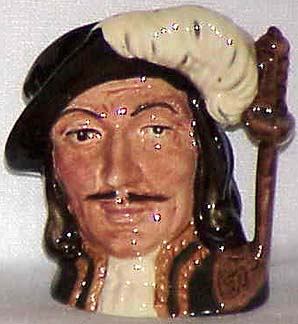
Chesterton reminds us that the age-old principle of chivalry demands the knight fight not because he hates what is in front of him, but because he loves what is behind him. I repeatedly invite persons who love our Lord's holy Catholic Church, who pray for the renewal of Christendom, for our Holy Father, Benedict XVI - the 265th pontiff since St. Peter - and for the restoration of families, to join the chivalric order known as Corpus Christianum.

Yet unlike the ancient monastic practicing a balance of ora et labora, of these two - praying and fighting - I would say that the proportion in chivalry is undoubtedly 99.99% of the former and 0.01% of the latter.** Indeed, of the two, the practice of prayer is the absolute requisite for any kind of warfare, spiritual or otherwise.

Many do not know that Don John of Austria went to the Battle of Lepanto with a likeness of Our Lady of Guadalupe affixed to the wall of his quarters. That is a good practice for all of a knightly bent.

If you do decide to pursue membership in Corpus Christianum, I strongly suggest you begin a sustained practice of what is called Acta Militum, which is found at the website under Frequently Asked Questions. It will steer a course of constant prayer through out your month.

**That is, of course, unless you consider the inalterable fact that most our battles are fought in our own heart and soul; then the ratio becomes again 50:50.

Rome Before the Brits - Chesterton

BRITAIN WAS DIRECTLY ROMAN for fully four hundred years; longer than she has been Protestant, and very much longer than she has been industrial ... Britons were not originally proud of being Britons; but they were proud of being Romans ... Rome itself obviously could not rule the world, any more than Rutland. I mean it could not rule the other races as the Spartans ruled the Helots ... A machine so huge had to be human; it had to have a handle that fitted any man's hand. The Roman Empire necessarily became less Roman as it became more of an Empire; until not very long after Rome gave conquerors to Britain, Britain was giving emperors to Rome. Out of Britain, as the Britons boasted, came at length the great Empress Helena, who was the mother of Constantine. And it was Constantine, as all men know, who first nailed up that proclamation which all after generations have in truth been struggling either to protect or to tear down.

- G. K. Chesterton, A Short History of England

Saturday, August 21, 2010

Laetare - Joy in Sorrow

IN PROPORTION AS WE ARE GOOD Christians, the world will find us dull dogs, a little removed from its insensate pursuit of pleasures, a little obsessed with thoughts of death and of judgment, a little sceptical about its facile optimisms. But, again, in proportion as we are good Christians, this seriousness of character will not reflect itself in empty brooding on the wickedness of the world, will not make us morbid, self-centered, disillusioned. Rather, we shall find that Christian sorrow and Christian joy have their roots nearer together than we fancied; that the desire for God's will to be done perfectly in us and in all creatures, which is the Christian religion, bears a double fruit of sadness and of gladness. For so it must be, until our earthly Lent is over, and we rejoice for ever in the triumph of the eternal Easter-tide.

- Ronald A. Knox, Sermon preached at St. Charles Borromeo, London

MacDonald - Lilith

MR. RAVEN, OTHERWISE KNOWN as Adam, explains the inexplicable - the rationale for abortion - in George MacDonald's book, Lilith:

She fears, therefore hates her child ... The birth of children is in her eyes the death of their parents, and every new generation the enemy of the last.

Friday, August 20, 2010

Saint Bernard of Clairvaux

My spiritual director who died in June on the feast day of Sts Peter and Paul said that Saint Bernard of Clairvaux was the "air we breath" at Holy Cross Abbey, Berryville. I had asked him for a good place to begin reading St. Bernard. He sent me a voluminous letter with multiple photocopies, suggestions, one with the still intriguing title of The Family That Overtook Christ: the amazing story of the family of Bernard of Clairvaux.

We remember St. Bernard today as founder of a host of monasteries, the counselor to pontiffs, the figure whom Dante deemed worthy to escort his literary self into Paradise.

St. Bernard, son of knights, pray for us.

Thursday, August 19, 2010

Knox - Creed, Warfare, Loyalty, Romance

WE CANNOT BE CONTENT, like the average Protestant, with repeating to ourselves that certain spiritual ideas, certain avenues of approach towards the unseen, have been helpful to the Christians of other ages, and therefore may well have an abiding value for us too. We are committed to a creed. The Catholic religion is very much more than a creed; it is a life, a warfare, a loyalty, a romance. But it is a creed too; and the assertion of it involves us in an intellectual responsibility. Man's intellect is part of himself, and must be represented, consequently, in the scheme of his salvation ...

We shall get no credit for it; we shall still be called liars. But we can put up with that, when we remember that the eternal Wisdom of the Father came down to earth and was hailed as a deceiver (Mtt 17,63). If only they knew what it means to be a Catholic! God grant that they may come to know.

- Ronald A. Knox

Sunday, August 15, 2010

Invitation - Corpus Christianum

ON THIS GREAT FEAST DAY of the Assumption into Heaven of our Blessed Lady, I heartily invite you to prayerfully consider becoming a chivalric member of Corpus Christianum.

As our website declares, we are in full commitment to and agreement with the Magisterium of the holy Catholic Church:

CORPUS CHRISTIANUM is an international Private Association of the Faithful, open both to men and women, dedicated to praying for a renewal of Christendom.

Marian in character and guided by a Catholic chivalrous spirit, Corpus Christianum members pray daily for the following key points:

- The renewal, unity, and spread of Christendom

- The Supreme Pontiff and all priests/religious

- The protection of Christians around the world

- The restoration of the family

- The conversion of sinners and the sanctification of all people

I have found, personally, a vast deepening of my faith, hope, and charity by my daily commitment to the Acta Militum of Corpus Christianum.

May God bless you this blessed day of Our Lord's Resurrection and feast day of Our Lady.

Saturday, August 14, 2010

Knox - The Sanctus-Bell

I COULD TALK TO YOU for hours and hours about Church bells. Why are they christened, for example, like human beings? I don't mean they get the grace of faith, but there is a kind of christening ceremony, and they are given names. That's surely odd; nothing else in church gets a name given to it. You would think it very unusual if I started calling the alms-dish Percy. I suppose bells are so much mixed up with the important events of our lives; the wedding peals and the funeral chimes and so on, that the medieval people used to have a kind of friendly feeling for them; they were the public pets of the village. They were also supposed to drive the devil away, and I must say I know a lot of Church bells that would drive me away if I were the devil. But we really haven't time to talk about all that ...

It seems to me a very queer notion that at High Mass anyhow, when the priest has been singing his way so vigorously through the Preface, and the choir with great chords on the organ to get through the Sanctus, a tiny little bell in the sanctuary should have the effect of waking the faithful up. I should have thought that kind of faithful would have needed a siren. No, honestly, I think it's all part of this business about the holy Angels, and the priest having the feeling that he's just arrived at the door of Heaven and can look through the key-hole. Having arrived at the door, we ring the bell. And we don't do it to amuse ourselves; we do it to show the holy Angels that we are there. "Please say that Mary Jane has come to call" -- that is the point of the Sanctus-bell.

- Ronald Knox, The Mass in Slow Motion

The Bleak Shall Inherit the Earth?

I see that our commander-in-chief has personally endorsed the building a mosque at Ground Zero.

It just goes to show that anyone is capable of using logic to argue his way into an incredibly bad idea.

St. Maximilian Mary Kolbe

“Courage, my sons. Don’t you see that we are leaving on a mission? They pay our fare in the bargain. What a piece of good luck! The thing to do now is to pray well in order to win as many souls as possible. Let us, then, tell the Blessed Virgin that we are content, and that she can do with us anything she wishes.”

- St. Maximilian Mary Kolbe, when first arrested

Friday, August 13, 2010

Parable of the Day-Laborers

Is it not lawful for me to do what I will with mine own? Is thine eye evil, because I am good? -- Matthew 20,16

HERE ARE YOU WHO have been a daily communicant all these years, living in the fear of God, practising meditation; the whole of your past years seem a vista of first Fridays, and yet your prayers are so cold, so dull, so destitute of spiritual consolation! And there is So-and-so, yesterday's convert, with a past which charity forbids you to contemplate, overwhelmed with sweetness and tenderness and every sort of sensible devotion. Must not there be some flaw here in the divine economy? Well, you have your answer. Is it not lawful for God to do what he wills with his own? Must you frown because he smiles, criticize because he lavishes his rewards? His grace is free, else what would be your own's position? His grace is free; how then should your unworthiness limit it?

Hear, if you will, attentively, faithfully, fruitfully; hear, if you will, incredulously, scornfully, with hostility; but do not say that Christ our Lord left us with nothing but a string of moral maxims or a series of devotional considerations, do not pretend that no theology comes from Galilee: in secret he has said nothing. The claim he made for himself and for his Church was enough to make the Jews crucify him; we, too, if we will only listen, must either crucify or adore.

- Ronald Knox

Wednesday, August 11, 2010

Knox - Making Heaven Populous

Note to readers: Ronald Arbuthnott Knox converted to the Catholic Church in 1918 after being ordained an Anglican priest in 1912. His father was also an Anglican priest, bishop of Manchester, lest anyone think this decision came easily, fighting a national church, family, and friends.

I admire greatly Monsignor Knox and hope that you will come to see that his thought is original, brilliant, and not given to well-worn troughs of repetition. He does not dodge or quibble with the Church's truth the way 'careful' commentators tend to do.

CATHOLICISM, THEY SAY, DRAINS the life-blood of a nation by its untimely insistence on the claims of the other world. And we have to answer again with a parable. We only know one thing for certain about this mysterious many-sided world on the shores of which we were cast upon at our birth, that God is our Father, that he has planted a vineyard, and told us to go and work in it. Yes, it looks ugly enough now, rows and rows of poles with strings running in between, but that was what he told us to do, and we suppose there must be something behind it all. We do believe that man cannot be called upon to undertake what grace cannot enable him to fulfil.

We do believe that external acts done for God's sake, even if in this world they are fruitless, will earn his commendation. We do believe that the first duty of Catholics is to make heaven populous. And the lip-service which merely applauds pious sentiments and likes a dash of religion about its newspaper articles, but does not alter the lives and the hearts of those who make their tribute of it, is, to us, a grudging and an unfilial apology for doing our Father's will.

- Ronald Knox

Take Your Tolkien

Have you read your Tolkien lately? Don't settle for watching Peter's Jackson's film version, extraordinary as it is for lending you images for your imagination. Rather, delve into the long conversations and deep, poignant thoughts, and mythopoeic narrative of a thorough-going Catholic thinker and writer, devoted to the Real Presence of Our Lord in the Holy Eucharist.

Here is not "escapism" so-called. Here is sub-creation and magic that comes not from without relationship, but from within that which we call Providence.

Sunday, August 8, 2010

Knox - Probation


(W)E ARE NOT TOLD of any specially grave sin that Dives committed; pride, hypocrisy, self-satisfaction, the leaven of the Pharisees, brought him to the pass we know of. His purple had blinded his eyes to his spiritual needs, while Lazarus' running sores were enough to keep him in mind of his spiritual infirmities. It is not enough simply to know, as a theological proposition, that we are on our probation here; we have to apply that knowledge and live in the light of it. There are so many other things to be done in the world, so many echoes that deafen us, that we are apt to forget the first principle of our probation, which is this: that the most important moment of our lives, the moment around which all the rest of our life ought to be grouped as its centre and its climax, is the moment when we leave it...

The real commercial equivalent of our life on earth is not so much pleasure, so much fame, so much love from those around us, so much attractiveness to our neighbours, but so much done for God. We are on our trial; there is a term to our effort, a limit to our opportunity. And the time is short and the end sudden. Blessed are those servants whom the Lord, when he comes, shall find watching.

- Ronald A. Knox