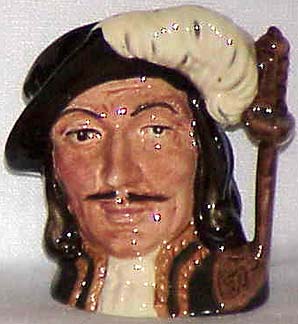
Each morning, right after fulfilling my chivalric duties of devotion, I spend a minimum of fifteen minutes reading. Usually the author who receives my undivided attention at this time is Monsignor Ronald A. Knox (Eton, Oxford). During World War II and the German bombings of industrial and municipal centers, Monsignor Knox had the opportunity to retire to the countryside of England to work on his translation of the Bible. Sounds idyllic, doesn't it? So it is amazing how the Holy Spirit sees things, most often, differently.
Friday, April 29, 2011
'Opportunities' in Catholic Education
Each morning, right after fulfilling my chivalric duties of devotion, I spend a minimum of fifteen minutes reading. Usually the author who receives my undivided attention at this time is Monsignor Ronald A. Knox (Eton, Oxford). During World War II and the German bombings of industrial and municipal centers, Monsignor Knox had the opportunity to retire to the countryside of England to work on his translation of the Bible. Sounds idyllic, doesn't it? So it is amazing how the Holy Spirit sees things, most often, differently.
Monday, April 4, 2011
Sicut Cervus - The Spirit's Work
Wednesday, December 22, 2010
Old Saint Nick

As I posted back on his actual feast day, Benjamin Britten did the world a thing of beauty by memorializing the events of the life of Saint Nicholas of Myra in his moving Saint Nicolas Cantata. And I noticed that Tim Jones posted on Chesterton's views of Saint Nick at Old World Swine, while young Andrew Cusack did also on the saint's day.
This, in my way of thinking, allows me the license to capture and republish both of their illustrations (above).
If you get an opportunity, do listen to Britten's gift of love for Saint Nicholas. (Reposted from 12/17/08)
Wednesday, December 1, 2010
Advent Vigil
This depiction of a knight kneeling before an altar has always symbolized the season of Advent in my mind. There is nothing ornate about the surroundings; nothing to spur on one's faith or hope or charity. In fact, it seems rather dark and cold and lonely.Tuesday, October 26, 2010
Hope of Glory - Knox
Saturday, August 28, 2010
Saturday Night - Rise and Come with Me

Friday, August 20, 2010
Saint Bernard of Clairvaux
My spiritual director who died in June on the feast day of Sts Peter and Paul said that Saint Bernard of Clairvaux was the "air we breath" at Holy Cross Abbey, Berryville. I had asked him for a good place to begin reading St. Bernard. He sent me a voluminous letter with multiple photocopies, suggestions, one with the still intriguing title of The Family That Overtook Christ: the amazing story of the family of Bernard of Clairvaux.Saturday, August 14, 2010
St. Maximilian Mary Kolbe

Friday, August 6, 2010
From Notre Dame to Notre Dame
I always find it bolstering to see young adults choosing to light candles rather than curse the darkness. Andrew Cusack once again provides his readers with a photomontage of the annual pilgrimage from the Cathedral of Notre-Dame de Paris on the Île de la Cité (above) to Notre-Dame de Chartres in the Orléanais by pilgrims young (and old). Enjoy - here.
Monday, May 24, 2010
Our Lady Help of Christians

Tuesday, May 18, 2010
Newman - Red Meat for the Soul
Monday, April 26, 2010
Monday Morning - for the record
Sunday, April 25, 2010
Tuesday, April 20, 2010
Friday, April 2, 2010
Tuesday, March 9, 2010
Chaput - Cans and Can't of Catholic Education
The Church does not claim that people with a homosexual orientation are “bad,” or that their children are less loved by God. Quite the opposite. But what the Church does teach is that sexual intimacy by anyone outside marriage is wrong; that marriage is a sacramental covenant; and that marriage can only occur between a man and a woman. These beliefs are central to a Catholic understanding of human nature, family and happiness, and the organization of society. The Church cannot change these teachings because, in the faith of Catholics, they are the teachings of Jesus Christ.
The policies of our Catholic school system exist to protect all parties involved, including the children of homosexual couples and the couples themselves. Our schools are meant to be “partners in faith” with parents. If parents don’t respect the beliefs of the Church, or live in a manner that openly rejects those beliefs, then partnering with those parents becomes very difficult, if not impossible. It also places unfair stress on the children, who find themselves caught in the middle, and on their teachers, who have an obligation to teach the authentic faith of the Church.
Most parents who send their children to Catholic schools want an environment where the Catholic faith is fully taught and practiced. That simply can’t be done if teachers need to worry about wounding the feelings of their students or about alienating students from their parents. That isn’t fair to anyone—including the wider school community. Persons who have an understanding of marriage and family life sharply different from Catholic belief are often people of sincerity and good will. They have other, excellent options for education and should see in them the better course for their children..More>>
Thursday, January 28, 2010
CT Scan Tomorrow
Marian chivalry consists in trusting as Our Lady did, obeying humbly as simply as earth (humus) accepts all that befalls it, offering up all woe and trials, and witnessing to God's steadfast love and faithfulness at all times, even when the path seems darkest, loneliest, most dread-filled, and hopeless.
Those who believe they are "in power" aren't; those who think they are powerless, aren't; those who fear the worst rarely face it; those who think they are prepared find they aren't. In this way Tolkien's master opus is the very finest teacher of reality; and it is a Catholic reality, after all.
Our Lord constantly sends us signs and portents of hope. Stay in a state of grace and so be ready to accept them open-handed.
And, if you find a moment, pray for me, like you, a poor ornery sinner, in need of even more grace. Thank you, gentle reader.
Tuesday, December 29, 2009
Thursday, December 10, 2009
The Chivalry of Father Kapaun
At sunrise on Easter Sunday, March 25, 1951, Father Emil Kapaun startled POWs by donning his purple priest’s stole and openly carrying a Catholic prayer missal, borrowed from Ralph Nardella.
He had talked atheist guards into letting him hold an Easter service, a favor they soon regretted.
No one there would ever forget this day. The most moving sight the POWs ever saw.
At sunrise, 80 officers — bearded, dirty and covered with lice — followed Kapaun up a little rise, to the cold steps of a bombed-out church. They gathered in a circle around him. Kapaun held a crude crucifix made from broken sticks. He looked thin and filthy; except for the black eye patch, he looked to Walt Mayo like one of the ragged apostles.
Kapaun began speaking, and his voice caught; he said he didn’t have the equipment to give them a proper Mass. But then he held up his ciborium, the tiny gold container that before his capture had held communion hosts he had placed on tongues of soldiers.
He opened Nardella’s prayer missal, and as he began to recite from it, the Christians among them realized what a risk he was now taking. He was beginning not from the Easter promise of rebirth but from the dark brutality of Good Friday.
As the guards glared, Kapaun read the Stations of the Cross, describing Christ’s condemnation, torture and death. Captives who had been mocked and tormented and beaten listened as Kapaun spoke of Christ being mocked and tormented and beaten.
Tears flowed.
Kapaun held up a rosary. He asked the non-Catholics to let the Catholics indulge for a bit; they knelt as he said the rosary, recited the glorious mysteries of Christ rising, ascending, defying death for all time.
A voice rose in song. A POW, Bill Whiteside, had a beautiful voice, and he raised it now to sing the Lord’s Prayer, a recital that gave goosebumps to Sidney Esensten, the Jewish doctor.
Kapaun spoke. His theme: forgiveness.
And he said he did not feel qualified to advise them about life because, “I am not any better than you are.”
Then they all sang as Kapaun had taught them: loud so that the enlisted men could hear. Starving men sang at sunrise, the same song Whiteside had sung, the Lord’s Prayer, a song they laced with reverence..Read all …
If in the dark days of an Advent filled with news like "hope and change" mandatory funding of abortuarial murder (read: "health care reform") that makes America resemble ancient Carthage, or the Scimitar threatening lands once part of Christendom (again), remember this:
Father Kapaun was only human. What he did was perform his priestly duties faithfully. Our Lord and his Real Presence in the Holy Eucharist empowered the prisoners of war. He will continue to do so for us, prisoners in an unholy age.God bless our faithful, wise, and loving priests. And God bless us as we gain sacramental grace and strength to be witnesses, joyful, jovial, chivalrous sons and daughters of the Most High. God bless you this Advent!
Monday, November 9, 2009
Good Christian Men, Rejoice
As the attempt to strangle Christian faith, morals, and traditions gathers momentum, from multiculturalism on the ascendancy in the Last Self-Help Administration and left in the United States and the EU on the continent, Christianity in general and the Catholic faith in particular will find itself more and more under siege. The above is the neo-pagan "pincer" confronting Catholic truth, faith, and morals. "Neo-pagan?" you may ask. "Is it not rather radical secularism in word and deed?"
No, it isn't. Only if one listens to its themes and self-justifying slogans. Observed through a cool, forensic lens of René Girard's mimetic theory, the structural behavior betrays its pagan pomp and ritual, right down to its Molech-like abortuarial cultus.
The other "pincer" attacking the remnants of the Christian West is, of course, the Scimitar. Again, it betrays its claims of "monotheism", let alone being a religion of "peace", by its necessary dependency upon victims for its sacrificial pyres of regeneration.
The two "pincers" are unlikely bedfellows, but both writhe and roil before the revealed faith, morals, and truths of the Church. Both hate (and secretly admire and desire in rivalry's side-long glances) what they can only reject, revile, and seek to destroy. Both are enslaved to this mission of destruction, for both house a collective mind trapped in mimetic rivalry to Catholic truth. As Robert Hamerton-Kelly describes this trapped mind:
“It is a mind enslaved. It desires not only to possess the other, but to consume or destroy. It wishes not only to imitate the other, nor merely to possess itself in the other, but to destroy the other as the place where the self is alien to the self.”