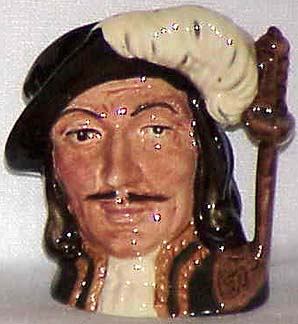
Most importantly, if one remembers Chesterton's Flying Inn, here is Flossie Lane’s obituary.
Wednesday, July 8, 2009
RIP - Flossie Lane
Most importantly, if one remembers Chesterton's Flying Inn, here is Flossie Lane’s obituary.

Catholicism - Faith and Reason

Just as Benedict XVI releases his new Encyclical CARITAS IN VERITATE (and which Elizabeth Scalia, 'The Anchoress', juxtaposes neatly with Pixar's great little Partly Cloudy), I think it is important for Catholics to remind themselves of something.
Protestants do not connect all the dots that we do as Catholic Christians. We see the Holy Father bring forth an invaluable letter of instruction for the faithful in the world. We also see the inevitable plethora of commenting about it by this and that authority in the Catholic press constellation. Protestant Christians furrow their brows and wonder, "Why do they (Catholics) give so much importance to what that old guy in fancy white robes writes?" They may even add, "It just isn't faithful to Jesus our Lord to make old Pope Benedict so important."
Catholicism for Protestants is a massive hookwinking, bait-and-switch scheme. Remove the pure, New Testament faith that each and every generation has access to, and replace it with this vast conspiracy of hierarchy, power, and mumbo-jumbo.
And, the truth be told, often Catholics have been too gullible and, sorry to say, ignorant of Catholic truth. All it takes, for example, is one beautiful, young, sincere Evangelical coed who asks, "Where is the Pope mentioned in the Baa-bull?" and young Joe Catholic may even discard the patrimony of the Church for good (or in this case, bad).
Catholicism is a vital (that is, living) mixture of faith and reason - and I mean reason. It consists of a near-never ending string of therefores: a is true, and b is true; therefore c must also be true. And if c is true and d is true, it follows, therefore, that e is also true ...
So, it is with admiration that I lift up Lydia McGrew's excellent post at What's Wrong with the World regarding evidence for the historicity of the New Testament. I have heard a similar (and better) examination for the historicity of the New Testament documents given by the president of Christendom College, Timothy T. O'Donnell, STD, KGCHS. But this is one of those starting points that shows first things about which Protestants and Catholics must agree.
And, by the way, the beginning of the papacy is found in St. Matthew's Gospel, chapter 16, when Our Lord appoints St Peter the first Pope. Benedict XVI is our 266th.
UPDATE: Father Robert Barron's first impressions on Caritas in Veritate here.
Blairs - Let's Do the Church
Do the "converts" Tony and Cherie Blaire have a new pet project? Damien Thompson thinks so.
Pardon me - Where's My America
For the record [ht: New Advent] - Sharia comes to Dearborn, Michigan.
Tuesday, July 7, 2009
Christ and His Church First
 Father Barron reviews the film The Stoning of Soraya M. here. (Eight minutes well spent.)
What Father Barron so needfully points out in referring to the seminal anthropological insights of René Girard is that scapegoating is how humans nearly always organize ourselves: we come to a "lowest common denominator" of agreeing who to blame, exclude and sometimes kill. As Girard says, "unanimity minus one."
In our Judeo-Christian past, we can see clear evidence of this use of violence. But it is the work of the Holy Spirit in history that has made it more and more difficult to use effectively, as our concern for the victim has increased. Our Lord, in St. John's Gospel, chapter 8, makes it unequivocally clear that only he who has no sin can "cast the first stone."
Compare this with the rise of Sharia law which "The Stoning of Soraya M." is based. Sharia law says God's will is with the ones stoning the certifiable law-breaker. The Christian faith says that God in Jesus Christ is one-with every victim of such "sacred" violence "since the foundation of the world - shown perfectly in His Crucifixion.
Politicians implicitly know the power of what Girard calls "the scapegoat mechanism," because they implicitly understand the power of the crowd (read: the voting public). But, as the Gospel works in history, the power of the scapegoat mechanism is undermined. Even the use of it undermines it all the more, because the very casting out of any new victim recreates the holy Event of the Passion of Our Lord that was its undoing.
Our Last Self-Help President is a master of the crowd. But he himself is still beholden to the power OF the crowd (Girard explains the prestige of the king/shaman in diverting the mob's murderousness onto another victim through the accusatory gesture).
Indeed, the United States in November's elections was heaving another attempt to revivify the scapegoating mechanism. Why? Because this is all we humans know.
The only way to thwart the scapegoating mechanism and all the kingdoms of the world is through the Gospel that Our Lord revealed to us in His Crucifixion and the vindication of His Resurrection.
We carry this faith, hope, and charity with us out into our world when we leave the Sacrifice of the Mass, the one and only place where we join with Our Lord in His grace and by His grace.
All other associations - no matter how noble, patriotic, nationalistic, or tied to a piece of land or history - are doomed to the way of the scapegoat mechanism. There is no "Best of --- " anything, except what Our Lord brings to us in His holy Catholic Church.
But by being good Catholic Christians, we can be fine patriots, citizens, countrymen/women, and friends. The reverse is never, ever the truth.
Lifestyles of the Rich and Clerical

 One needn't look with scorn or dismay at paintings executed with such realism as those exhibited at The Gentleman’s Journal.
After all, where would civilized food, drink, discussion, and culture be without such?
Un-trashing Neo-Thomism
 For the record, R. R. Reno at First Things:
Read all of Defending Truth.Fr. Garrigou-Lagrange, O.P. (1877–1964), was the twentieth-century Catholic theologian whose outlook and intellectual projects epitomized the confident intransigence of the pre-Vatican II Church. Professor of theology at the Angelicum in Rome for many decades, Garrigou-Lagrange taught Aristotle and St. Thomas to many generations of seminarians. As a consultant to the Holy Office, he played an important role in the intellectual politics of mid-century Catholicism. His reputation was clear: hardnosed about truth and in favor of the use of church authority in its defense ...
Neo-Thomism was trashed by progressives in the aftermath of Vatican II. “It fails to take history serious. The theology is remote from the real experience of modern men and women,” we were told. In the place of the Neo-Thomist synthesis, the Rahnerians promised a transcendental theology that would magically transform subjective categories into the language of faith. History, social context, personal experience—these human-centered phenomena would somehow extend the hand of friendship to the official teachings of the Church.
Garrigou fought against the new theologies that were advanced in the decades immediately prior to Vatican II. Indeed, his opposition was notorious. In the late 1940s, Henri de Lubac was bitter about “the kind of dictatorship that Father G-L is trying to exercise in the Church.” But Garrigou was prescient. Indeed, less than two decades after Vatican II, Henri de Lubac would end up ringing the theological alarms, reiterating the spirit if not the letter of Garrigou’s clear and rigorous Neo-Thomism.
I have never understood the animus against Neo-Thomism in the post-Vatican II Church. By my reading, the Second Vatican Council was a remarkable event, one that endorsed all sorts of changes and new directions in the Catholic Church. Historians rightly emphasize these changes. Yet, all the bishops who attended the Council, all the theological advisors who drafted the documents that were eventually adopted, all the major players were educated within the Neo-Thomist synthesis. Garrigou himself was the teacher of many important figures at the Council. Therefore, by any responsible historical judgment, the creative and lasting significance of the Council necessarily owes a great deal to the supposedly antiquated and discredited manual theology of Neo-Thomism.
We need not rely on generalizations. John Paul II was a young bishop at Vatican II. Throughout his long pontificate, he remained enthusiastic about the achievements and significance of the Council, especially the renewed emphasis on the Church’s engagement with the world. The Church contributes to world by speaking the truth about our humanity, a truth vouchsafed in Christ, a truth that must be spoken in season and out. And who directed Karol Wojtyla’s doctoral dissertation? Réginald Garrigou-Lagrange.
Neither Peddicord nor Nichols ask us to turn back the clock. We don’t need to, because time seems to be catching up with Garrigou. As Nichol’s observes, Garrigou consistently saw relativism as the “generative principle” of errors, and he saw “the need to re-establish the ‘exigence of truth’ for both culture and life.” Today, Pope Benedict XVI denounces the “dictatorship of relativism” and calls for the renewal of a culture of truth.
Monday, July 6, 2009
The Church in the East
 Sometimes a man
 stands up during supper
and walks outdoors, and keeps on walking,
because of a church that stands somewhere in the East.
And his children say blessings on him as if he were dead
And another man, who remains inside his own house,
dies there, inside the dishes and in the glasses,
so that his children have to go far out into the world
toward that same church, which he forgot.
- Rainer Maria Rilke
Discussion surrounds the origins of arguably the most original pieces of fiction of the twentieth century, Tolkien's Lord of the Rings and Lewis's Chronicles of Narnia. Both involve the elements of Romance, chivalry, and the numinous that were clearly so absent from (so-called) Modern literature at the time of their inception. Both authors, Oxonian dons, were well schooled in the Classics and Greats. Both had first hand experience of the evils of warfare in the time of the industrial revolution, wounds won in battle, and personal loss.
I would suggest that Rilke's man who "who remains inside his own house, dies there, inside the dishes and in the glasses" is the careful man, the focus group statesman, the man for whom such concerns as Romance, chivalry, and the numinous are mumbo-jumbo of childish things.
Lewis and Tolkien knew better, and differently.
When the careful, gesture-making statesman meets with the Pontiff this week in Rome, I hope that he remembers that the children of this present age still have needs that far transcend the fluff of day-time television. And if he is not careful to factor in these needs, they may "go far out into the world toward that same church, which he forgot."
And that same Catholic Church is still here to set us on our Journeys of Romance, chivalry, and the numinosity of the Incarnation, the Crucifixion, the Resurrection, and the Church Militant.
'Edoras' - Mt. Sunday, Canterbury
 The magnificent site of Tolkien's Edoras for Peter Jackson's version of The Two Towers: Mt. Sunday, New Zealand.
Sunday, July 5, 2009
The Meeting
Regarding this meeting, count on the un-president seeing to it that an "accident" happens that makes the Holy Father seem foolish, off-balance, shamed in some way, while he, the un-president, looks good, righteous, a somber, intelligent messiah before the old ways of the disposable West.
He is keen on gestures and the nonverbal cues and signals.
The only world leader he has kowtowed to was the Saudi (you saw the picture of the non-bow). All else with disdain. The un-president never knew what it was to grow up in real American community, the grange down the way, the courthouse steps, the Gaffers as elders. These he resents with a vengeance.
But be assured, this meeting and scorn with the Holy Father will merely be a reenactment of the Crucifixion: the very ontological moment when the power that the un-president depends on was undone.
Wednesday, July 1, 2009
Piotr Stanczak - Martyr and Hero
That he was Polish does not surprise me. I came to learn and admire a lot about the Poles under John Paul the Great.
Monday, June 29, 2009

Prevaricating for all of us
Victor Davis Hanson:
I still cannot quite believe Obama thinks that chattel slavery in America was ended without violence. Or that Islam was responsible for unprecedented breakthroughs in advanced math, sophisticated medicine, and printing, let alone that it served as a catalyst for the Renaissance and the Enlightenment.Read all of Hanson's Obama and the ‘Noble Lie.’
Instead, Obama seems to believe that fudging on facts is not fudging, but simply offers a competing narrative that gains validity by its good intentions. Most Americans, Obama further believes, are either too dense or too uneducated to discern his misinformation. But they will at some future date appreciate the global good will that results from his feel-good mytho-history.
No one in the Arab street is going to object when Obama assures us all that Islamic felonies — religious intolerance, gender apartheid, coercive government — are equivalent to American religious and gender misdemeanors. Hitler made up stories about World War I and German minorities in Eastern Europe for murderous racist reasons. His ignoble lies are in no way similar to present-day noble lies that are offered for exactly the opposite goal of promoting religious tolerance and global brotherhood.
[ ... ]
So why does President Obama so often get history wrong, so often call for utopian schemes he would hardly adopt for himself, and so often distort by misinformation and incomplete disclosure?
Partly the culprit is administrative inexperience, partly historical ignorance. But mostly the disconnect comes because Barack Obama believes he is a philosopher-king, whose exalted ends more than justify his mendacious means.
In other words, Obama is our first truly postmodern president. And the Guardians who form his elite circle — in the very manner that they once falsely accused neo-cons of doing — deliberately, but “nobly,” distort the truth on behalf of us all.
The Post-Am Presidency
For the record: John Bolton on the man who has written two - count them, two - autobiographies already in The Post-American Presidency.
This is substantiated by Spengler's superb analysis at AsiaTimes.com.
This is substantiated by Spengler's superb analysis at AsiaTimes.com.
Subscribe to:
Posts (Atom)