Saturday, May 31, 2008

Existential Dread, or Hope

Tolkien said in a personal letter to his son the following on the Holy Eucharist:
"Out of the darkness of my life, so much frustrated, I put before you the one great thing to love on earth: the Blessed Sacrament ... There you will find romance, glory, honour, fidelity, and the true way of all your loves on earth, and more than that: Death: by the divine paradox, that which ends life, and demands the surrender of all, and yet by the taste (or foretaste) of which alone can what you seek in your earthly relationships (love, faithfulness, joy) be maintained, or take on that complexion of reality, of eternal endurance, which every man's heart desires."
If this seems to maudlin to the modern reader, may I suggest you do the following: (a) have a near-miss with cancer; (b) realize what you love and value, and how little time you have in this existence; (c) ask what will remain when you die, which you will do. Then reread Tolkien's words (above), and, after asking yourself this question - "Who am I to argue with the man who wrote The Lord of the Rings?" - read this:

"It is existentially impossible to despair in the (real) presence of Jesus."

- Edward Schillebeeckx (quoted by Gil Bailie)

Paganism - Then and Now I, II, III

Paganism - Then & Now: Part I Part II Part III

Blair - Using "Religion" for Peace

THIS should be good. Oops - sorry! Open mike. Hrm! I honor convert Tony Blair's intent here, but merely conscious, "enlightened" intentions must be humble before the realities of human culture - something even seasoned politicians like Blair probably underestimate.

Fortunately, Blair is now a Catholic. Here is the greatest hope for his new project.

Culture of Death Candidate Opines


A video of Barack Hussein Obama in which he says that the Christian right "drives people apart." Perhaps one might say, "Cafeteria Christian-Leftist Politician Drives People Apart?"

Friday, May 30, 2008

Paganism, Then and Now - Pt. III

In Part I, we looked at paganism's characteristics, as described by the psychoanalyst, Jeffrey Burke Satinover. In Part II, we examined the process of hominization and creation of culture as posited by cultural anthropology of René Girard, what he calls mimetic theory. In a smoothly running conventional culture, myth, ritual, and prohibition kept the sacrificial center, the "primitive Sacred" of religion, holding cultures of antiquity together with social and psychological cohesion.

But, people being what they (we) are, Girard shows that myths worldwide show not only the necessary scapegoat mechanism at the heart of culture, but also cultural breakdown from time to time. Gil Bailie, for my money the best popularizer of mimetic theory, explicates in his book,
Violence Unveiled (Crossroads, 1996), a myth of the Toltec peoples that shows exactly this crisis: a time when an "economic" sacrificial mechanism needing only one or a few victims moved to an inefficient and murderous cultural development - one that usually signals the death-throes of a culture. (This myth of Quetzalcoatl and Tezcatlipoca can be read on pp. 99ff.)

Western civilization is now by all accounts in this stage of cultural dilapidation. Robert Hamerton-Kelly says that a certain indicator of a culture that is losing its centripetal power to hold its people together socially and psychologically is seen in a bipartite characteristic - its need to throw
more victims into the sacrificial mechanism, or more prestigious victims: genocide or regicide. Democracy itself, he theorizes, is the cultural concretization of the death of kings (Louis XVI, Charles I). The 20th century shows graphically the decline of the West using this indicator.

What Girard discovered in his groundbreaking studies in cultural anthropology - "mimetic theory" - was the effect of the Gospel in history. He was flabbergasted as any scholar would be to turn in his literary and mimetic studies to the New Testament and find that the Bible seemed to understand the dynamics of mimetic theory as well or better than he. (I suggested strongly to the reader both Girard's
Violence and the Sacred [Johns Hopkins, 1977] and The Scapegoat [Johns Hopkins, 1986] in this regard.) I won't go into all of his findings, but this is a quote from his book, Things Hidden Since the Foundation of the World:
“Jesus is not there in order to stress once again in his own person the unified violence of the sacred. He is not there to ordain and govern like Moses; he is not there to unify people around him, to forge its unity in the crucible of rites and prohibitions. But on the contrary, to turn this long page of human history once and for all" [204]
In the crucifixion of Jesus, Girard saw what many 19th century anthropologists and theologians saw: the similarity of the Christian Lord's death to the dying and rising god of ancient myth. But he saw, more importantly, in the Gospel, for the first time, a narrative in which the crowd was wrong and no myth proclaims that the "god" re-established social cohesion. Rather, the Gospel said that the crowd crucified an innocent Victim; that his followers did not seek or reek retaliatory vengeance; that this Victim returned from the dead (structurally identical to the "Corn King", Dionysus, Osiris, et al), but came forgiving and commissioning his followers to say that he was one-with ALL victims of similar violence "since the foundation of the world," and the power of the mob was wrong, satanic, and not of his Kingdom.

How "satanic"? Recall: etymologically, the Greek word "satan" is synonymous with "the accuser." It is the
accusatory gesture that establishes the first notions of human culture ("It's HIS fault!"); the murder or casting out of the scapegoated victim is the second part of originary culture-making scene. By definition, Satan is the "murderer and liar from the beginning" who creates all the world's kingdoms and powers (Jn 8). Astonishingly, the Greek word used in the New Testament for the Holy Spirit, "paraklete" means "counselor for the defense," "comforter," one who stands with the accused.

Girard was overwhelmed to see in the Gospels an alternative to the conventional cultures of the world universally depicted in the anthropological record. This new Kingdom was initiated, said the Church (unified for 1,500 years +/-), by a loving, forgiving, and self-disclosing God who went to the extreme measure of becoming one-with us (the Incarnation), suffering our human bloodthirstiness to the point of death (the Crucifixion), and rising from the dead not to reek havoc, but to offer repentance and a new Way of being in the world (the Resurrection and giving of the Holy Spirit at Pentecost); namely, the ecclesia, the Church. This Way did not expel or murder a victim or victims to convene itself (ask what cultures demand this today). Rather, the Church into which this Risen Lord invites all peoples convenes by gathering around the "lamb slain since the foundation of the world," his Altar, his Word, his Love. The Sacrifice of the Mass he instituted so that we would not again seek human victims to do the satanic thing.

+ + +

Where has this Gospel brought us? At its high point, it brought to flower Christendom. Yes, reform was essential and called-for, but the so-called "reformation" began a scourge that has led Christendom to the brink of breathtaking demise. Shall it find unity and a restoration? Or, will the primitive Sacred swallow it in its two-pincer vice-grips of postmodern nihilism, on the one hand, and the religion of the Scimitar on the other once and for all?

Shakespeare Among the Ruins


I cannot emphasize enough the work of Clare Asquith, Shadowplay, and the video by Michael Wood, In Search of Shakespeare. The former is the definitive code-breaking hermeneutic for the works of the Bard, sine qua non. The latter is, for the sheer human necessity of seeing the primary history documents, places, and, well, things of Shakespeare's life (the wedding bed of Anne and William, his family's Catholic parish, father John Shakespeare's will, the city map showing where he lived in London with the Charles Mountjoy family on 'Muggle' Street). (Take note Potter fans: Who or What might "Fawkes the Phoenix" be, pray tell? Does Rowling even know?)

Essential reading. Essential viewing. Far and away better than the The DaVinci Code tripe and piffle. You couldn't make this stuff up!

Paganism, Then and Now - Pt. II

In Part I, I employed the work of Jeffrey Burke Satinover to list the predictable characteristics of unfettered human nature; i.e., the pagan (Girard's "primitive Sacred"). In this post, I want to review in my own short-hand the origins of those characteristics according to the "mimetic theory" of René Girard. I encourage readers to send questions, concerns, and corrections to the comments box (below) should you find what may very well be egregious errors in this endeavor (too much alliteration?).

Girard's mimetic theory posits an originary scene that pre-dates culture; meaning, there is not yet any "us". A prime tenet of mimetic theory is that humans are "mimetic" - contagiously imitative - as are all primates. That's why we "ape" one another. But to current western attitudes, we'd rather die than admit that we copy anybody. Since Rousseau, we endeavor even to hide this fact from ourselves; bbut if we are honest, we all have models. Madison Avenue knows it about us, however, quite well.

So, being mimetic before culture, Girard proposes the
acquisitive gesture: somebody reaches for a delicacy - fruit, sexual partner, whatever - and others copy the desirous gesture. But there is a limited commodity. So, Hobbes's "war of all against all" kicks in.

When it looks as though all hell will break loose, the acquisitive gesture that was so contagious is replaced by a peace-making gesture: the
ACCUSATORY gesture. Somebody (prior to language, a product of culture) points and says, 'All this is HIS fault," and this gesture is mimicked with lightning like rapidity.

The beginning of culture! WE suddenly all agree about something and we have a culprit. This is the lowest common denominator of culture: a victim we can all agree to expel and/or murder. Girard calls this, "unanimity minus one." The
esprit de corp literally develops around the dead body of the one who is the agreed-upon wrong-doer.

This only brings us to the
very beginning of culture. The crowd feels very good about itself after the murder, but also in Girard's estimation, very humbled. How could peace come about so abruptly, after chaos was so close? Clearly a god did it. Indeed, the victim who we thought caused the problem came to bring us peace by allowing us to kill him.

This is the beginning of a tripartite set of essentials for human culture:
myth, ritual, and prohibition.

The
myth is the story of how the god came in our time of distress, allowed us to kill him, and brought us peace and social harmony. Myth allows us to feel good, even "righteous", about our violence: the god caused it. We did the right thing in killing him; it is what he expected and wanted us to do.

The
ritual is the beginning of what is religion, anthropologically speaking: religare - literally, a binding back, to the founding event of culture. It is the formalizing that originary founding violence in a ritual complete with priesthood to see that it is remembered correctly and efficaciously.

When things again become chaotic, socially and psychologically, the priesthood ratchets it up a few notches (release of violent prisoners, etc.), then the originally scene is played out again using a certifiable "bad guy" as victim. Caiaphus in John's Gospel says it well: "Better that one shd die than the whole nation be destroyed." The ritual re-establishes order, and, when done well, it is economic: only a single victim is sufficient.

Prohibition, the third element, is what keeps culture from getting too near flash-points that could ignite social chaos before the priesthood can contain things with ritual. Thus, conventional cultures always place taboos around murder, adultery, etc. - those things that can bring social solidarity to its knees.

These are all elements of traditional pagan culture, in Girard's understanding. Western civilization certainly contains such elements, but Girard discovered something in his studies, long after he developed a thorough-going theory: the Christian faith.

He didn't assume the truth of the gospel, he discovered it well after his studies took him, finally, to the New Testament and, thence, back to the Old. The biblical spirit is very much at-odds with the pagan spirit of what he calls "the primitive Sacred."

Part III - The effect of the Gospel on history, culture, and violence.

Paganism, Then and Now - Pt. I

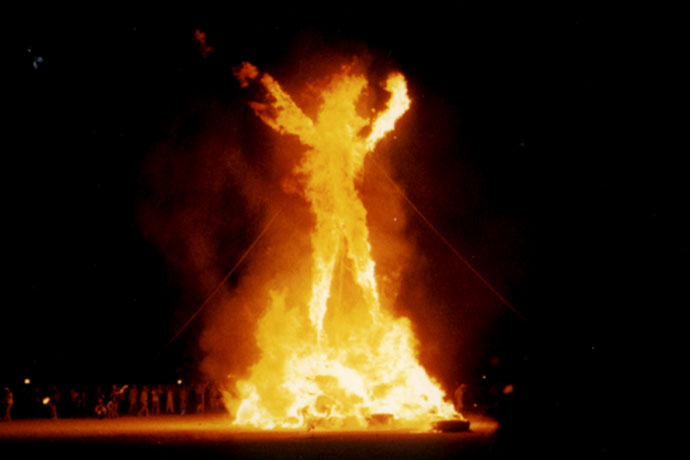
C. S. Lewis also said once, "The best lie is the one closest to the truth." The love of lore, the medieval, simpler times is fine; but without the influence of Christian faith, it quickly recrudesces into the merely pagan. Witness the new age schlock around what was once the heart of the Christian West in England: Glastonbury. Instead of the heart of the Christian faith it has become a ridiculous place of every Wicca enthusiast, et al. Witness, too, the Burning Man phenomenon (pictured above) in the Nevada desert in the United States.

Let us look at the phenomenon of paganism. In three posts, I will examine its characteristics, first from a psychoanalytic point of view, given to us by the former President of the C. G. Jung Foundation, Jeffrey Burke Satinover. Dr. Satinover also served as a lecturer at both Harvard and Yale Medical Schools, and now resides in Israel. In parts two and three, I will attempt to lay out some of the stunning anthropological insights of the French scholar, René Girard. Girard approached and compiled what he called "mimetic theory" first as a historian (PhD, Indiana University) and then as a literary critic. Dr. Girard was inducted into
the Académie française in March 2005. Both men, coming from their respective disciplines, conclude that
the pagan is our human default position, culturally and psychologically. Without the influence of the biblical spirit, Satinover says, the pagan contains the following:

"First, of course, paganism is polytheistic. Each individual (or in more primitive, homogeneous societies, each group) feels himself subject to his own god or goddess. At a practical level, this means that the distinctive values, standards, goals, and laws of each deity govern the lives of that deity’s worshipers. Thus pagan society is polyvalent: a single moral standard does not govern the lives of men, and except by force majeure, no god, and no corresponding set of human values, is superior to any other. And, as a consequence, pagan societies tend to become inegalitarian. For different standards for different groups is something that inevitably leads to factional competition; and in time force majeure indeed becomes the rule-might soon comes to make right. Zeus rules because he is strongest, and for no other reason; he is certainly not the wisest.

"As we know, pagan society is pantheistic or animistic: gods and goddesses inhabit the natural world and are one with it; nature itself is worshipped as divine; there is no serious distinction between creature and creator. Again, on a practical level, this means that men worship not only the nature "out there," they also worship their own nature, which is to say, their instincts: e.g., hunger, sex, and aggression, and more generally, pleasure. In thus spiritualizing the instincts, pagan worship therefore tends naturally to the violent, the hedonistic, and the orgiastic. Pagan religious ritual arouses the instincts, especially sexuality and aggression, to the keenest possible pitch. In the subsequent gratification of these instincts, the greatest possible pleasure and hence also the highest level of religious ecstasy is meant to be achieved. Violent intoxication, temple prostitution, the ritual slaughter of enemies, self-mutilation, even child sacrifice: all these historical phenomena can be understood not as pathological, but as predictable end-points to the unfettering of human nature..."
I encourage the reader to read the essay from which this excerpt is drawn, Jungians and Gnostics. Satinover, as a former Jungian and trained psychoanalyst pulls no punches; he merely states the facts from the anthropological record.

What this means for today is not measured necessarily in self-labeled neo-pagan's behavior and/or beliefs. Rather, they are the demonstrable effects of a rejection of the biblical faiths, Judaism and Christianity, in what was once a culture greatly influenced not by our fall-back pagan origins, but a Judeo-Christian ethos at-odds with the aims of paganism for 2,000 years.

But as Anglican bishop
Michael Nazir-Ali notes, the slippage of biblical influence has created a vacuum that is being filled by two great pincers of the primitive Sacred: postmodern nihilism and the Scimitar.

In part II, I will review Girard's perspective on hominization and the origins of human culture, and how culture world-wide contains the visible remnants of its violent origins.

Neuhaus - CA's "Raw Judicial Power"

Father Neuhaus limns the outlines of the crisis of distinctions in its California "gay" marriage form at First Things in Disingenuousness and Clarity.

Crisis of Distinctions - Progressive Pipe Dream

Yet more evidence of the "sacrificial preparation" proceeding apace with the requisite "crisis of distinctions" - ”Guv strikes state's gender-specific restrooms”

Girard's mimetic theory posits that such break-downs of prohibitions are not only necessary but predictable prerequisites that lead to ritualized re-enactment of the founding violence of a culture. At least, that's the game plan hard-wired into conventional culture. However, few or no such politicians as the Colorado "governor" in the above article have knowledge of this innate sacrificial mechanism at the heart of human culture. For such "progressives" they are doing the next forward-thinking "thing" in the name of multiculturalist ideology - namely, "tolerance" - in what they think will lead to but never call "utopia". Once it is said, the silliness is too apparent, even for "progressives".

Conventional cultures knew very well the reasons for their prohibitions or taboos: it was to keep the populace from straying too dangerously close to flash-points such as murder, adultery, and other such staple (cf. the Book of Leviticus for examples). They knew that such trespasses could lead to the fracturing of communities and societies in escalating, spiraling retribution and retaliation. (Think Hatfields and McCoys, Palestineans and Israelis, Northern Ireland Catholics and Protestants.) The "progressive" pipe dream of eliminating all such distinctions as sexual identity, gender specificity - the ancient yet hard-wired cultural taboos - is a predictable lead-up to the cultural chaos, the "sacrificial preparation," just prior to the orchestrated sacrificial event by a priesthood.

But where is the priesthood of the primitive Sacred today? Those who remember and are trained to carry out such sacrificial violence? The faiths of the Bible have ever tried to move humanity away from the primitive Sacred (read some René Girard if you don't think so), starting with God's words to Cain ("Your brother's blood cries out to me from the ground.") and leading to the Cross ("Father, forgive them; they know not what they do.") But the "priests" of a another so-called monotheistic religion are trying sacrifice all the time. Read the headlines: beheadings, "honor killings," jihad, qital.

Western "progressives" never, ever put together two words which are the endzone of their "tolerance" efforts: "human" and "sacrifice". Their myth still blinds them to it; else how can they miss what Old Testament prophets would spot in a heartbeat - child sacrifice to Moloch?

So, tell me again, why is this man in the picture smiling?

Thursday, May 29, 2008

An Important Read

David at Brits at Their Best posts on the intrepid and clear-sighted Anglican bishop, the Right Reverend Michael Nazir-Ali, the Bishop of Rochester, in "You don't know what you've got till it's gone." The comments on the nihilism of multiculturalism are particularly cogent.

Cardinal Jean-Louis Tauran

From The Guardian.co.uk: [h/t: Dhimmi Watch]

Cardinal Jean-Louis Tauran, the Pope's principal adviser on Islam, said that while the majority of Muslim clerics condemned acts of terrorism, they needed to be more vocal about jihad, especially because of its frequent appearances in the Qur'an.

The cardinal made the remarks after a lecture, given in London to an audience of students, Catholic clerics and figures from other religions. It was one of several public appearances during a rare visit to the UK.

He said: "In the Qur'an you have several interpretations of jihad - violent and holy. Most Muslims are condemning war made in the name of religion. The problem is that in the Qur'an you have good and bad jihad, so you choose.

"There is no worldwide authority who can interpret the Qur'an, so it depends on the person you have in front of you. Sometimes you should like religious authorities to be more outspoken about violence in the name of religion. But Muslims believe the Qur'an is the divine word of God, so it is a problem."

He said it would be "easier" if there were a single Islamic authority to negotiate with. "It's a great difficulty there are many voices of living Islam."

Well said, Cardinal.

Wednesday, May 28, 2008

Myth, Ritual & Modern Prohibition Release

In a conversation (if comboxing can be called conversation) with Pastorius at Infidel Blogger’s Alliance, I spoke of the way that conventional cultures are the concretization of three offshoots of cultural founding violent origins, according to René Girard: myth, ritual, and prohibition.

Of these, prohibitions were taboos that warned and were strongly enforced due to the powerful flash-points they guarded. Murder, adultery, theft, false witness - any of them were capable of setting fire to a community with retributive violence that, human nature being what it is, could escalate and spiral into culture-destroying events. (Look in the Old Testament book of Leviticus for scores of examples.)

But, it is important to recall that when the centripetal power of a culture's religion (L. religare - to bind back) began to lose its power to maintain social and psychological cohesion, the priesthood knew that ritual, if properly performed, would re-establish the cultic "pull" at the heart of their culture. It would "bind" the people "back" to the founding violent origin once again. To help surcharge the ritual event, often taboos and prohibitions would be relinquished - violent prisoners released on the streets, sexual "friskiness" allowed, etc. This would "ratchet up" what Girard, Oughourlian, and LeFort discuss in Things Hidden Since the Foundation of the World: "sacrificial preparation."

Then, when the sacrificial ritual took place, the denouement would be all the more cataclysmic and cathartic. This is what Nietzsche longed for in his notion of the "eternal return" of pagan religion: a culture-restoring worship of the dark gods of blood.

So? So what? Well, those who study mimetic theory say that the present events -- the relinquishing of taboos -- carry with them all the indicators of a "sacrificial preparation." Certainly those who believe they are carrying out some deformed brand of multicultural "progress" don't realize this. They think they are just helping to bring about an utopian dream to reality. So this, for example, does not frighten anyone - except those with residual cultural memory of what the "crisis of distinctions" (Girard) can do to a culture.

For now ritual does not work - at least not this side of the crucifixion and resurrection of Christ. (Why it no longer works is a topic for a different post.) Now, sacrificial events carry with them "moral hangovers," PTS syndromes, and worse. Robert Hamerton-Kelly even hypothesizes that now ad hoc self-appointed "priest" of the primitive Sacred try to surcharge sacrificial events with greater numbers of victims and great prestige of victims: genocide or regicide. This is a prime indicator that a culture's sacrificial center is failing; i.e., the Aztecs. It is no longer "economical". Democracy itself, he says, is the result of the death of kings, but modern western attempts to invoke the sacrificial mechanism are failing yet murderous in the extreme.

If you doubt this, think about what the 1960's were if not an attempt at the kind of frenzy leading to sacrifice. Think JFK, MLK, Jr., RFK. Think (further back) the Holocaust. Think (now closer) Rwanda. Darfur. 9/11.

And lest the West think it is coming to its senses, think of the millions - millions! - of abortions that take place, and the quietest, least heard victims offered to Moloch today.

John Paul II spoke lengthily of the "culture of life" vs. the "culture of death." How, if not with mimetic theory, would you try to understand the bloody 20th century, let alone what looks like an even bloodier 21st?

Scimitar-filled Vacuum

Clear-sighted Anglican Bishop, Michael Nazir-Ali (the one with the temerity to speak of "no-go zone" Muslim enclaves), now speaks again with insight. From the article:
...the "social and sexual" revolution of the 1960s had led to a steep decline in the influence of Christianity over society which church leaders had failed to resist.

He said that in its place, Britain had become gripped by the doctrine of "endless self-indulgence" which had led to the destruction of family life, rising levels of drug abuse and drunkenness and mindless violence on the streets.

The bishop warns that the modern politicians' catchphrases of respect and tolerance will not be strong enough to prevent this collapse of traditional virtues, and said radical Islam is now moving in to fill the void created by the decline of Christianity.

Read all …

The influence of the Gospel was, as historian Hilaire Belloc said, the defining element of the West. "The Faith is Europe. And Europe is the Faith." When this departs, it is only two or three generations before a culture reverts to the recrudescence of what René Girard called "the primitive Sacred." Surely not at a culture's center, which will hold for a while; but at its fraying edges.

The bishop is right: into the vacuum left by the rejection of the Christian faith enters, in this case, the Scimitar. And by all criteria of which I am acquainted, the Scimitar is ostensibly an expression of the primitive Sacred, regardless of its proponents' claims to revelation.

"By their fruits you shall know them."

UPDATE: You've seen it elsewhere, but for the record: The COE opines that England will be a Muslim state w/in 30 years.

Royal Tournament - Teamwork

If you like watching teamwork, this is extraordinary. For more see: Royal Tournament.org.