Saturday, January 10, 2009

Which Direction
The farther persons are from the influence of the Gospel, the more likely that this will begin to occur. It will seem as though such mob violence is acting like a prairie brush fire: quenched in one place, it will flare up elsewhere as though ignited by an unseen root system. This is the "dry tinder" Our Lord warned of (Jn 15,6) that is only fit for conflagration.
So, ask yourself: is this good news or bad news?
Strider at the Prancing Pony
 Aragorn's Lay
 'Beauty Is Making a Comeback'
 John Murphy at Godspy writes on the indelible necessity of beauty (along with truth and goodness, of course):
The fact of Original Sin makes ignoring humanity’s fallen state impossible for the artist, which is why the Christian mode of beauty can have a sublime terror or despair, as in Michelangelo’s Last Judgment or Górecki’s Symphony of Sorrowful Songs. With reference to the unblinking naturalism of O’Connor’s prose, the Archbishop of Canterbury wrote, “The tightrope that the Catholic writer must walk is to forget or ignore nothing of the visually, morally, humanly sordid world, making nothing easy for the reader, while doing so in the name of a radical conviction that depends on that world being interrupted and transfigured by revelation.” Thus, Christian faith does not limit but rather expands an artist’s sensibility for the simple reason that Christianity is all-inclusive of joy and suffering, hope and despair, sin and redemption. As JRR Tolkien put it, “there is no story without the fall.”
By becoming “subcreators” with God of authentically beautiful art that is both of its time and suffused with perennial truth, artists can participate in a new kind of evangelization. In the words of Image journal editor Gregory Wolfe, “Beauty is making a comeback.” (His own journal testifies to this). Ron Hansen’s slim, haunting novel, Mariette in Ecstasy, published in 1992, belongs on a shortlist of the great Catholic novels. Another recent example was the remarkable success of The Passion of the Christ, with its Caravaggio-inspired visual scheme. More telling, perhaps, is the spate of secular art that taps into the deep vein of Christian philosophy—the bruising beauty and life-affirming message of Alfonso Cuarón’s Children of Men, the sophisticated albums of singer-songwriter Sufjan Stevens, the near-biblical pitch of Cormac McCarthy’s prose, or the Christ-infused finale of the Harry Potter series. The experience of great art, whether religious or secular, nearly always has a spiritual dimension—an interstice in daily life where the luminous eternal breaks through.
The luminous eternal is truth, goodness, and beauty. Of the three, beauty may be the best proselytizing force because we respond to it willingly, happily. Whether the object of our attention is a striking painting, a lyrical prose passage, or a glorious piece of music, humans are hardwired to delight in beautiful things. To adopt Oscar Wilde’s formula, Beauty is higher than Genius because it needs no explanation. It simply is. That is why modern art relies so much on theory.
Beauty is not just icing on the cake; beauty is substantial, essential. In his introduction to the Glory of the Lord, the great theologian Hans Urs von Balthasar addressed the mystery of beauty and its utter necessity. I leave him with the final, eloquent word:
“Beauty is the disinterested one, without which the ancient world refused to understand itself, a word which both imperceptibly and yet unmistakably has bid farewell to our new world, a world of interests, leaving it to its own avarice and sadness. No longer loved or fostered by religion, beauty is lifted from its face as a mask, and its absence exposes features on that face which threaten to become incomprehensible to man. We no longer dare to believe in beauty and we make of it a mere appearance in order the more easily to dispose of it. Our situation today shows that beauty demands for itself at least as much courage and decision as do truth and goodness, and she will not allow herself to be separated and banned from her two sisters without taking them along with herself in an act of mysterious vengeance. We can be sure that whoever sneers at her name as if she were the ornament of a bourgeois past – whether he admits it or not – can no longer pray and soon will no longer be able to love.”
Friday, January 9, 2009
Worth a Thousand Words
Darwish - Shariah Threat
Thursday, January 8, 2009
Who Wants Abortion, Really?

WASHINGTON—A nationwide survey commissioned by the United States Conference of Catholic Bishops (USCCB) has found that four out of five U.S. adults (82 percent) think abortion should either be illegal under all circumstances (11 percent) or would limit its legality. Thirty-eight (38) percent would limit abortion to the narrow circumstances of rape, incest or to save the life of the mother; and an additional 33 percent would limit abortion to either the first three or first six months. Only 9 percent said abortion should be legal for any reason at any time during pregnancy. (My Emphasis)
"These findings are remarkable," said Deirdre McQuade, Assistant Director for Policy & Communications at the USCCB's Secretariat of Pro-Life Activities. "Fewer than one in ten Americans support legal abortion for any reason at any time during pregnancy. But that is precisely the current state of abortion law under Roe v. Wade and Doe v. Bolton, the 1973 U.S. Supreme Court decisions that made abortion legal throughout the nine months of pregnancy for virtually any reason."
The survey of 2,341 adults, conducted online December 10-12, also found that laws limiting or regulating abortion enjoyed support as high as 95 percent among those expressing support or opposition to the six kinds of laws examined in the survey:
- 95 percent favor laws ensuring that abortions be performed only by licensed physicians
- 88 percent favor informed consent laws (i.e., that require abortion providers to inform women of potential risks to their physical and psychological health and about alternatives to abortion)
- 76 percent favor laws that protect doctors and nurses from being forced to perform or refer for abortions against their will
- 73 percent favor laws that require giving parents the chance to be involved in their minor daughter's abortion decision
- 68 percent favor laws against partial-birth abortion (i.e., aborting a child already partially delivered from the mother), and
- 63 percent favor laws preventing the use of taxpayer funds for abortions.
"Support for these measures cuts across 'pro-life' and 'pro-choice' positions. Over a third (35 percent) of the small minority who said abortion should be legal for any reason throughout pregnancy nevertheless supported three or more of the six laws presented," McQuade said.
"This research indicates how out of touch pro-abortion groups are with mainstream America," McQuade said.
"These same widely-supported, constitutionally valid measures, some of which have been proven effective in reducing abortion rates, are now seriously threatened by abortion advocates and their allies in Congress," McQuade said. "On behalf of children and their mothers, we will have to fight to keep such laws in place."
"Pro-abortion groups have already sent a comprehensive 55-page blueprint for their agenda to the incoming Administration," McQuade said. "But their agenda—including publicly-funded abortions, passage of the so-called 'Freedom of Choice Act' (FOCA), and attacking the Hyde amendment and other longstanding pro-life provisions in appropriations bills—won't sell in the general public."
"Most people agree we should work to reduce abortions, but you can't reduce abortions by promoting abortion and eliminating all the policies that have proven effective in reducing abortions," McQuade said. "The U.S. Conference of Catholic Bishops will oppose all such threats to human life in whatever manner they are proposed."
If Satan acts like he exists, devises as though he exists, maintains a maniacal grip on power as if he exists, isn't it fair to say that Satan is the greatest enemy still facing the human race on planet Earth?
Or, as theologian Peter Kreeft reminds us, we forget at our grave peril with whom we are truly at war.
Wednesday, January 7, 2009
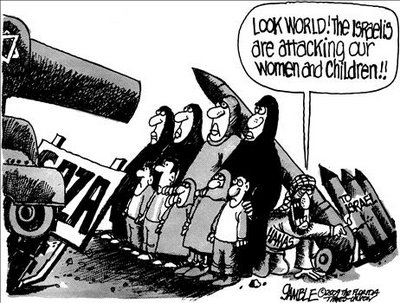
Children as Shields
Golda Meir said it best: "We can forgive you for killing our sons, but we can never forgive you for making us kill yours."
Clear Sighted Czech Cardinal Speaks Out
Cardinal Miloslav Vlk, the head of the Czech Roman Catholic Church, is adamant that behind the failure to adopt the euro-treaty is the absence of what Europe feels natural about - Christian values.
[ ... ]
Demographically dying out, Cardinal Vlk expects Europe to become markedly more Muslim in the 21st century because of the low fertility of Europeans the majority of whom are non-believers. It is a well-known fact that countries that are secularized reproduce more slowly than countries that are more pious.
"Muslims in Europe have much more children than Christian families. That is why demographers have been trying to come up with a time when Europe will become Muslim," Cardinal Vlk claimed.
While European Muslims are living their religion, Europeans are "pagans, as they do not respect their religion". To face the danger of dying out, Europe needs to install a program of spiritual rehabilitation.
"If we do not restore Europe in terms of Christian values, we will surely die out," Cardinal Vlk said.
Tuesday, January 6, 2009
Review - Aristotle at Mont Saint-Michel
 Thomas F. Bertonneau reviews Sylvain Gouguenheim’s "Aristote au Mont Saint-Michel: Les racines grecques de l’Europe Chrétienne" in The Brussels Journal. He quotes from Gouguenheim:
To proclaim that Christians and Muslims have the same God, and to hold to that, believing thereby that one has brought the debate to its term, denotes only a superficial approach. Their Gods do not partake in the same discourse, do not put forward the same values, do not propose for humanity the same destiny and do not concern themselves with the same manner of political and legal organization in human society. The comparative reading of the Gospel and the Koran by itself demonstrates that the two universes are unalike. From Christ, who refuses to punish the adulterous woman by stoning, one turns to see Mohammed ordaining, in the same circumstances, the putting to death of the unfaithful woman. One cannot follow Jesus and Mohammed.
Monday, January 5, 2009

Mark Steyn - Gaza Rocket Science
So how was your holiday season? Over in Gaza, whether or not they're putting the Christ back in Christmas, they're certainly putting the crucifixion back in Easter. According to the London-based Arabic newspaper al Hayat, on Dec. 23 Hamas legislators voted to introduce Sharia – Islamic law – to the Palestinian territories, including crucifixion. So next time you're visiting what my childhood books still quaintly called "the Holy Land" the re-enactments might be especially lifelike.
The Scimitar and Cancer
99 percent of Muslims are Muslims because their many times over great-grandfather was living in a village someplace when a group of men with swords marched in, and declared that they were all going to become Muslims now, or die horribly. Unless he was smart enough to get on board by being one of the men with the swords, and take home his share of the loot and slaves.
Today these people would be known as Muslim extremists. Back then they were just known as Muslims.