Tuesday, July 27, 2010

Knox - Politicians

A LITTLE BABY in a manger, a hunted criminal, a malefactor weighted with the instrument of his own punishment -- so our Lord looked to the world; not otherwise did his Church look -- does his Church look, to the scornful eye of the politicians that reject it. Christianity was the religion of slaves; it has abolished slavery. It was thrown to the lions in the amphitheatre; it has abolished the amphitheatre. Absolute monarchy, like a flustered giant, laboured to crush it; it has outlived absolute monarchy. Silently through the centuries the supernatural miracle has worked, like nature's miracle of fermentation.

- Ronald A. Knox

Monday, July 26, 2010

Corpus Christianum - An Invitation

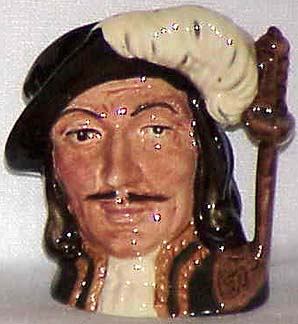
If there resides in your heart and soul an undying though perhaps tarnished image of knighthood - that is, a yearning and longing to lay your sword at the feet of a king worthy of your fealty - you are invited to partake in the goodness of Marian chivalry within the fellowship of Corpus Christianum.

The quest for such a King, and his good Lady, to whom one may serve joyfully with good comrades-in-arms seems like an unanswerable one; and yet, Corpus Christianum does exactly that.

Come. See if your heart does not swell with joy - and faith and hope and charity. These dark and mean days need all who will to serve our Lord and our Lady in chivalrous valor. You will be welcome!

Sunday, July 25, 2010

Knox - Catholic Truth

TODAY, WHEN THE WORLD has become so fuddled with its own philosophies that men cannot be sure whether two and two really make four, whether black is not really white under another aspect, they all agree on one thing -- that the Catholic religion can't be true. They will tell you one moment that it is impossible to discover whether truth exists, and the next moment that the Catholic religion is certainly false -- such is their logic. The Catholic religion must obviously be a deception, because it claims to know what is true.

-- Ronald Knox

Wednesday, July 21, 2010

Knox - Beyond Charity Alone

ALL THROUGH THE CENTURIES the Church has had to act in great measure as a nursing mother to the faithful, not content to be merely their teacher in the faith; providing schools, hospitals, orphanages, tending the sick, relieving the poor, burying the dead; she has drawn a whole network of charitable institutions across the world, vying with one another in the service of men's bodies. And always, that is not the point. With the other Christianities there is a constant risk that their spiritual message will lose itself in philanthropic endeavour. The movement which began in an access of burning zeal for men's souls will have been replaced, a century or two later, by a vast organization, religious in name, but merely philanthropic in purpose. With the Catholic Church, so much older than these others, it has never been so. Her message is of the world beyond; on it her eyes are set; she tends, feeds, teaches her children distractedly, only that she may point them to heaven; she will not lose her soul in what the world calls charity.

- Ronald A. Knox

Monday, July 19, 2010

George MacDonald - Philanthropy

THE (ROLE) OF PHILANTHROPIST is indeed a dangerous one; and the man who would do his neighbour good must first study how not to do him evil, and must begin by pulling the beam out of his own eye.

- George MacDonald

Knox - Sanctity of Persons

YOU PASS THROUGH THE STREETS as you go to your daily work, and all those thousands of your fellow beings - faces hardened by money-getting, faces impudent with the affectation of vice, faces vacant with frivolity, faces lined with despair - and it seems to you impossible that each one of those faces, with so little recognition in it of a divine vocation or of eternal destiny, can yet represent a soul for which God cares. And yet he does care, if theology is to mean anything; cares for this one as he ... cared for the penitent thief.

- Monsignor Ronald A. Knox

I have been scanning the usual blogs and websites of my BLRS (before liver resection surgery) days so much less these days: all the shrill, worrisome voices, clammering about this imminent social catastrophe or that. A pal whom I gratefully met on Enders Island, St. Edmund's Retreat - Mark Gordon - has been retreating also from those Cassandras and spending more time listening to the orthodox voices from Mother Church.

I'm not so much following his lead as performing triage with my time here on earth. You will read more from the good guide, Monsignor Ronald Knox (above), and less about the Scimitar, the secularization of the West, and other troublesome social matters here at Chronicles. It seems important for me - for the good of my - and your - soul. Best/blessings

Sunday, July 18, 2010

16th Sunday - Ordinary Time

Old Testament Trinity (1408-25) - A. Rublev

The LORD appeared to Abraham by the terebinth of Mamre,
as he sat in the entrance of his tent,
while the day was growing hot. 
Looking up, Abraham saw three men standing nearby. 
When he saw them, he ran from the entrance of the tent to greet them;
and bowing to the ground, he said:
"Sir, if I may ask you this favor,
please do not go on past your servant. 
Let some water be brought, that you may bathe your feet,
and then rest yourselves under the tree. 
Now that you have come this close to your servant,
let me bring you a little food, that you may refresh yourselves;
and afterward you may go on your way." 
The men replied, "Very well, do as you have said."

Abraham hastened into the tent and told Sarah,
"Quick, three measures of fine flour! Knead it and make rolls." 
He ran to the herd, picked out a tender, choice steer,
and gave it to a servant, who quickly prepared it. 
Then Abraham got some curds and milk,
as well as the steer that had been prepared,
and set these before the three men;
and he waited on them under the tree while they ate.

They asked Abraham, "Where is your wife Sarah?"
He replied, "There in the tent." 
One of them said, "I will surely return to you about this time next year,
and Sarah will then have a son."
-
Genesis 18:1-10a

Friday, July 16, 2010

Father Mark Delery - Requiescat in pace +

With the arrival of our diocesan newspaper, I was saddened yet not surprised to see that long-time friend and spiritual director, Father Mark Delery, had died.

Author, former abbot, medical doctor, fellow cancer survivor, Fr Mark was droll, insightful, wise, and, at times, hilarious. I was blessed on my last retreat to share with him my newest cancer battle news during spiritual direction, and he to hear my Confession and bless a few small articles I had brought with me. Too, he celebrated Holy Eucharist that Saturday morning at Holy Cross Abbey.

A soul guide, confidant, and friend. Pray for us, Fr Mark.

Wednesday, July 14, 2010

Knox - Guide for the Soul

RONALD ARBUTHNOTT KNOX (17 February 1888 - 24 August 1957) was not only one of the most brilliant minds at Oxford University in his day (admitted openly by C. S. Lewis), but one of the finest, most whimsical apologists, and explicators of orthodox Catholic teaching in the English speaking world.

During my recuperation from surgery, I read slowly and gratefully his book, The Hidden Stream, a series of conferences he gave at Oxford for Catholic students and other interested persons. I cannot speak highly enough about the book. If you wonder about who can be saved outside the Catholic Church, Christian marriage, the necessity of Revelation (to name only a few topics), get a copy. It will be worth it.

I am now delving into another book, The Creed in Slow Motion, talks he gave during World War II to girls who had been relocated during the bombing of London. Don't underestimate its value for ... hm ... you.

And, waiting in the wings is the rather large tome, Pastoral and Occasional Sermons.

Fighting cancer raises a host of questions in one's heart and soul. Monsignor Knox is a God-given guide for me. I can only offer his guidance, wisdom, concern, and love for you as well.

Friday, July 9, 2010

Invasion

Tired of trying to sort it all out? On overload from trying to manage the information universe?

Just remember: the Invasion has already occurred. It happened in the backwater of the Roman Empire in an insignificant cave-stable two thousand years ago. From now on, everyone is your neighbor. All we have to do is accept who we truly are and live on grace in the meantime in faith, hope, and charity with our neighbors. All of our neighbors.

Everything that we do should be a response to this Invasion of Grace, particularly in imitating the One Who invaded this planet that was under the dominion of a rebellious power who, in turn, held our species in slavery to sin and death. (For the history of our gracious Invader, read the Gospels of Matthew, Mark, Luke, and John.)

Wednesday, July 7, 2010

Or Else

The WaPo puts forth on its front page an article no larger than a man's hand regarding the poor sufferers of "Islamophobia" in Kenya of all places. I certainly woke up this morning concerned about elections in Kenya. Didn't you?

When, o when, will the self-arrogating arbiters of topics of public discourse ever look at the actual level of "tolerance" practiced by those poor victims of "Islamophobia" and compare it with their own self-designated level of "tolerance" promulgated by the designated by the humanist drivel known as "multiculturalism"?

But that really is not the issue, is it? Ultimately, it goes back to appeasement of our petro-overlords. Always follow the Mammon. And always - always - give them what they want.

Tuesday, July 6, 2010

And Where Did That Get Them

At least someone is comparing with history in mind. This is a far cry from the usual back-pedaling as soon as one realizes one is getting close to the brink of allowing truth to break in upon one's consciousness: Roman Infanticide, Modern Abortion

Friday, July 2, 2010

Jos. Bottum - Signpost at the Crossroads


You head down the road of public life in America, and you run up against religion. From the conversations in the barber shops and the coffee klatches, through the aldermen’s offices and the town halls, the school boards and the zoning commissions, the campaigns and the columnists, and eventually to the state houses and even, perhaps, to that white-domed Capitol building, far off in Washington—somewhere along the line you come to the crossroads where religion cuts across your path.

You travel the long road of religion in America, and you find the Bible chapels, scattered along the prairie like tumbleweeds that have somehow grown white vinyl siding. You drive past the green-lawn suburban churches with cutesy messages on the brick-framed signs placed out near the street. You pass the exhaust-stained marble fronts of the old city congregations, the yellow taxis inching angrily by. You visit the grand cathedrals and synagogues, announcing their people’s success in America, this newfoundland, and you see the pulpits and the choir lofts and the pews and the Sunday schools—the church basement halls, with their dented aluminum coffeemakers and styrofoam cups, their book tables, their after-service conversations burbling away. And somewhere down that highway you come, again, to the crossroads where the public life of the nation confronts you.

There is a marker at that place, naming its many promises and dangers for travelers, with the word
abortion at the top. Even now, abortion remains what it has been for more than thirty years: the signpost at the intersection of religion and American public life.

Of course, there are those who think this shouldn’t be so. Personally, I cannot see how abortion could not rank first. We eliminate 1.3 million unborn children in this country every year, a number that dwarfs, by far, the impact of every other activity with which the moral teachings of the churches might be concerned. For that matter, the story of abortion is a tale of blood and sex and power and law—I do not know what more anyone could need for public significance. The people who say they are uninterested in the issue of abortion have always seemed, to me, to be trying to suppress the imagination that most makes us human.

Nonetheless, even in the churches some do not see things this way, and they want the whole issue simply to go away. But the fact that they
wish abortion didn’t matter shows that abortion does, in fact, matter. It’s proof that the social observation remains true, for good or for ill. Whether one approves or not, the issue of abortion is here in America—the signpost at the crossroads.

Read all of The Signpost at the Crossroads here.

Thursday, July 1, 2010

Newman - Pilgrim Queen (1849)


The Pilgrim Queen (A Song.)

THERE sat a Lady
all on the ground,
Rays of the morning
circled her round,
Save thee, and hail to thee,
Gracious and Fair,
In the chill twilight
what wouldst thou there?

"Here I sit desolate,"
sweetly said she,
"Though I'm a queen,
and my name is Marie:
Robbers have rifled
my garden and store,
Foes they have stolen
my heir from my bower.

"They said they could keep Him
far better than I,
In a palace all His,
planted deep and raised high.
'Twas a palace of ice,
hard and cold as were they,
And when summer came,
it all melted away.

"Next would they barter Him,
Him the Supreme,
For the spice of the desert,
and gold of the stream;
And me they bid wander
in weeds and alone,
In this green merry land
which once was my own."

I look'd on that Lady,
and out from her eyes
Came the deep glowing blue
of Italy's skies;
And she raised up her head
and she smiled, as a Queen
On the day of her crowning,
so bland and serene.

"A moment," she said,
"and the dead shall revive;
The giants are failing,
the Saints are alive;
I am coming to rescue
my home and my reign,
And Peter and Philip
are close in my train."

The Oratory.
1849.

Reader - Are You Like Douglas Hyde?

THE ONE-TIME LEADER in British Communism, Douglas Hyde, astonished his twentieth century colleagues by seeing his name across national newspapers as having resigned his job as news editor of the Daily Worker and the Communist Party. He was becoming a Catholic.

Shortly before, he and his wife "outed" to one another and discovered that the Holy Spirit had been leading them in parallel direction. Joseph Pearce relates the events in his nonpareil must-read/own book, Literary Converts:

Hyde: "Are you becoming a Catholic or something?"

"I wish I were," she replied.

Hyde's heart leapt: "And I wish to God I could do the same."

For the first time in months they came clean with each other. Hyde told her exactly how far he had travelled. How he believed that the culture of the Middle Ages had not died with feudalism but was still alive in the modern world, 'a living Catholic culture' (243ff).

+ + +

If you are tired to death of the sham party politics of America, the present 'pharoah' who knows not Joseph (or Biblical faith and values from his progressivist place of power, only from afar); if you are like Douglas Hyde (though not so officially), exhausted by the mere human projects that keep ending, like those of the dark twentieth/twenty-first centuries, in Gulags, gas chambers, killing fields, Caliph-justified vitriolic violence, and Gulf water disasters ...


The July/August issue of The Saint Austin Review (StAR), July/August is entitled, The Middle Ages. I recommend strongly that you pick up a copy, or, better yet, subscribe to this journal that clear-sightedly views global events and culture from a stance faithful to the Magisterium of the Church.

What you yearn for and want most deeply may - just may - still be quite alive and flourishing in a world that you see, quite rightly, that has gone mad. "Well, that's your opinion," you say? I paraphrase Evelyn Waugh:

... the Church is not, except by accident, a little club with its own specialised vocabulary, but the normal state of man from which men disastrously exiled themselves.