Wednesday, May 7, 2008

Recusant Composers of Note

William Byrd

Susan Treacy, musical historian and writer for Saint Austin Review, gives a wonderful introduction to the Recusant musicians of the period known as the English Reformation under Elizabeth I. The following is drawn from her article published in StAR, November/December 2004, "Music of the English Martyrs and Recusants." The footnote re: the Gunpowder Plot is not from her article.

Many Catholics -- among whom research is including William Shakespeare as one (Shadowplay ; Shakespeare the Papist; Quest for Shakespeare) - continued to adhere to "the old religion" during this time of danger and deprivation. Some of the Catholic composers and musicians of note during this time include William Byrd (1543-1623), Thomas Tallis (1505-85), and Richard Dering (1580-1630).

Byrd and his teacher and sometime business partner, Tallis, issued Cantiones sacre in 1589, and a number of motets have texts that allude to the worsening situation of English Catholics. For example, Exsurge, Domine sets to music verses from Psalm 43:
Exsurge, quarew obdormis, Domine? Exsurge, et ne repellas me in finem,Quare faciem tuam avertis? Oblivisceris inopiae nostrae et tribulationsis nostrae? Exsurge, Domine.

Arise, O Lord: why sleepest Thou?
Arise, and reject me not for ever.
Wherefore hidest Thou Thy face and
Forgettest our misery and trouble?
Arise, O Lord!
One of the most famous manuscripts traditionally associated with suffering Catholics of this period is the Fitzwilliam Virginal Book, a manuscript of nearly 300 secular and sacred works for keyboard instrument. The same handwriting is used throughout and traditionally the author has been thought to be Francis Tregian the Younger (1574-1619) of a distinguished Catholic family from Cornwall. Composers whose works appear in the Fitzwilliam Virginal Book were either Catholic or had Catholic connections: Byrd, Tallis, Dowland, John Bull, and Peter Philips.

One of the 300 English martyrs was Henry Garnet, SJ, who was implicated in the Gunpowder Plot.** A Frenchman, Charles de Ligny, recorded that he "found Garnet in company with several Jesuits and gentlemen, who were playing music: among them Mr. William Byrd, who played the organ and many other instruments. To that house came, chiefly on the solemn days observed by the Papists, many of the nobility and many ladies by coach or otherwise."

Around 1617, Richard Dering found refuge in Brussels and there became acquainted with Peter Philips (1560-1633). A wonderful recording that juxtaposes the sacred music of Philips and Dering was released by the Choir of King's College, Cambridge (EMI 7243 5 66788 2 8).

Music from the Fitzwilliam Virginal Book can be found in recordings by Joseph Payne (Vox CDX 5085) and Ton Koopman (Capriccio 10211).

The Essential Tallis Scholars CD contains works by both Tallis and Byrd.

**Hiliare Belloc (1st History, Oxford) reports the following in his fine How the Reformation Happened: "The first date assigned to the conception of the Plot is March, 1604. The first hint we have of the Government's watching and 'nursing' it is April, 1604. The pretended 'discovery' is November, 1605. So it was 'nursed' in secret by Cecil for the full eighteen months." [footnote, 244]

Be Proud, Catholics (Humbly, of course)

Steve Ray, author, Catholic convert, DVD-series personality says that Jewish businessman, Sam Miller, is hopping mad at how the Catholic Church is smeared in America.

Tuesday, May 6, 2008

Tolkien - Catholic Culture

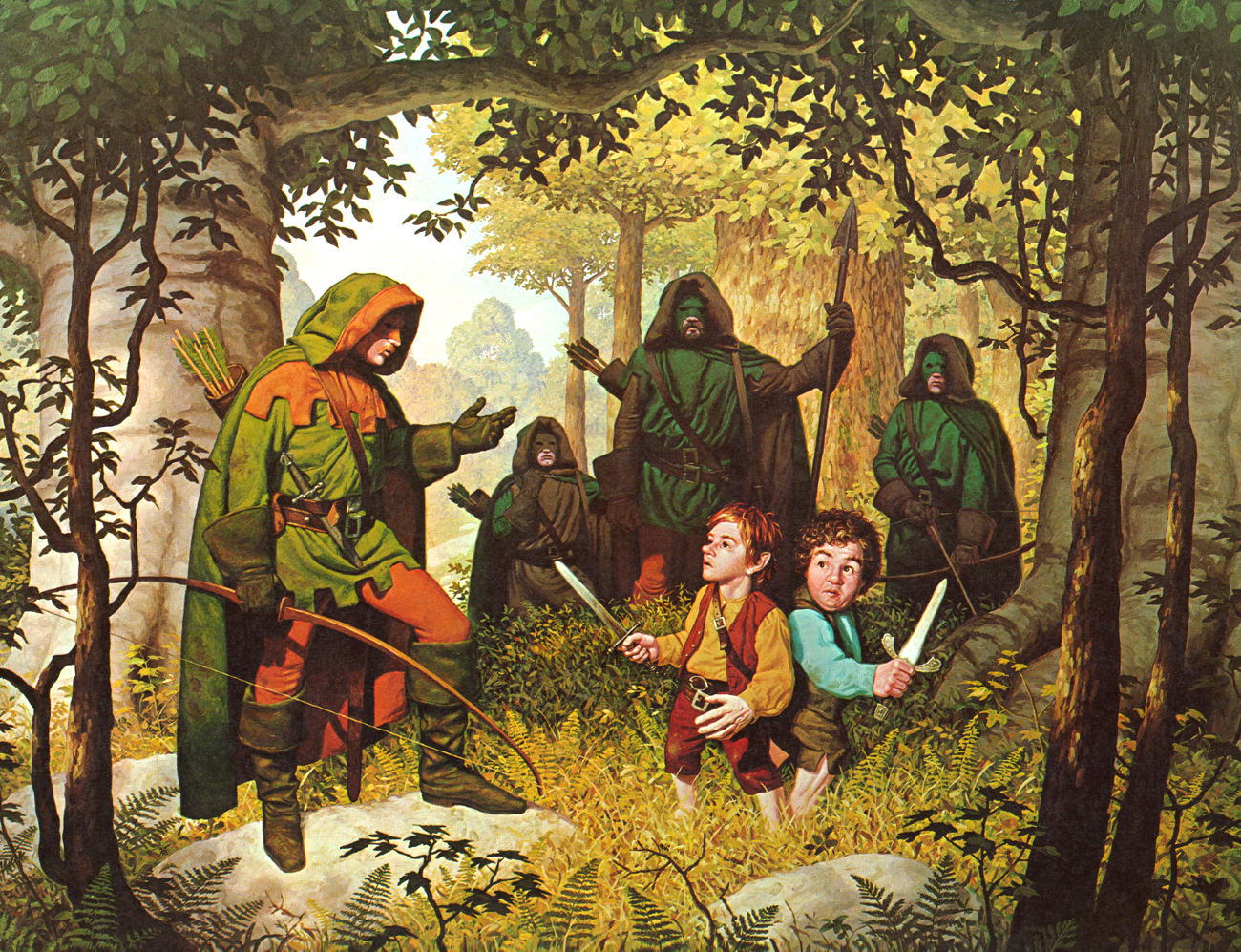
Strider and the Hobbits at the Prancing Pony - The Brothers Hildebrandt

Since I find that my fine Parochial Vicar, Father Dan Hanley, is also rereading J. R. R. Tolkien's Lord of the Rings, I offer the following as a very good introduction to the great man's life and work, Tolkien's Catholic Imagination, by Jason Boffeti.

Fighting a Dragon


One thing I am discovering is that when a person goes into battle with a dragon, one is at a distinct disadvantage on several fronts. First, one is weaker and has fewer innate weapons. Second, one has to lean heavily on good timing and something that we call variously "good fortune" or, for people of faith, "Providence". Most of all, regardless of how one may prepare to do battle with such a primeval monster, when it strikes, all plans are out the window and one must, finally, come into full awareness of one's mortality, ineptitude, and need for strength and dunamis well-beyond one's own puny powers, not to mention one's need for allies who can help when least looked for.

Two films that portray the truths listed above with great fun, alacrity, and acerbity (at least from the humans' point of view) are Reign of Fire (2002) and Dragonslayer (1981). Without the latter's magnificent dragon, "Vermithrax Pejorative," no film dragon would have any credibility to the present. What Disney did in creating him was as wonderful as the music score was atrocious (sorry, but true).

So this is a post about fighting dragons? No; it is about fighting a dragon closer to home and more real: cancer. All of the axioms in paragraph one above hold true. And I am grateful for all who have come to my assistance in prayer, skill, hope, and strength in fighting this "dragon".

May you find yourself surrounded by loving and caring help when the days that you must fight your dragons, gentle reader. Cheers and blessings.

As Goes Israel

What has Israel's survival got to do with us? Israel is far away. It has different enemies than we do. Even among Islamic extremists, they are battling Hamas, Hezbollah, the PLO and Islamic Jihad, while the West is confronting the Taliban and al-Qaeda.

Besides, if we're nice and accommodating of diversity, the terrorists will respect our attempts to honour their culture and faith and leave us alone.

Nice theory. Too bad jihadis of every label view Israel and the West as conjoined and inseparable. Even though we may not see our destiny as inextricably linked with Israel's, they do. If we give up on Israel, they will simply take that as a sign they might be able to pressure us next to give up on Quebec, Mississauga, Michigan, Birmingham and the Paris suburbs.

So writes Lorne Gunter of the National Post in As Goest Israel ... If the Jewish state can't survive the onslaught of militant Islam, neither can the rest of the civilized world. [h/t: Real Clear Religion]

Monday, May 5, 2008

Rossetti - PRB

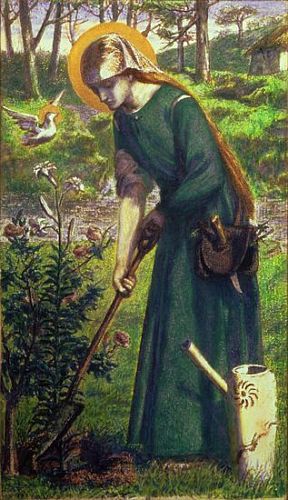
Mary Nazarene (1857) - Dante Gabriel Rossetti

Our Lady as a gardener: awesome!

Father Cantalamessa - Marriage

The Two Shall Become One Flesh
In their path toward perfection, the saints often go through the so-called dark night of the senses, in which they no longer experience any feeling, or impulse.

They have aridity, are empty, do everything through will power alone and with effort. After this, comes the "dark night of the spirit," in which not only feelings enter into crisis, but also the intelligence and will. There is even doubt that one is on the right road; if it has not all been an error; complete darkness, endless temptations. They go forward only through faith.

Does everything end then? On the contrary! All this was but purification. After they have passed through these crises, the saints realize how much more profound and selfless their love of God now is, in relation to that of the beginning.

For many couples, it will not be difficult to recognize their own experience. They have also frequently gone through the night of the senses in their marriage, in which the latter have no rapture of ecstasy, and if there ever was, it is only a memory of the past. Some also experience the dark night of the spirit, the state in which the profoundest option is in crisis, and it seems that there is no longer anything in common.

If with good will and the help of someone these crises are surmounted, one realizes to what point the impulse and enthusiasm of the first days was but little compared to the stable love and communion matured over the years.

If at first husband and wife loved one another for the satisfaction it gave them, today perhaps they love one another a bit more with a love of tenderness, free of egoism and capable of compassion; they love one another for the things they have gone through and suffered together.
Read all …

Sunday, May 4, 2008

Rossetti - PRB

Mary in the House of St John (1859) - Dante Gabriel Rossetti

The Way, the Truth, the Life

Madonna with the Host - Jean-Auguste-Dominique Ingre (1780-1867)
Musee d'Orsay, Paris

To Return to the High

(I)f the Rohirrim are grown in some ways more like to us, enhanced in arts and gentleness, we too have become more like to them, and can scarce claim any longer the title High. We are become Middle Men, of the Twilight, but with memory of other things. For as the Rohirrim do, we now love war and valour as things good in themselves, both a sport and an end; and though we still hold that a warrior should have more skills and knowledge than only the craft of weapons and slaying, we esteem a warrior, nonetheless, above men of other crafts. Such is the need of our days ... we have changed, declining from NĂºmenor to Middle-earth.

[ . . . ]

You have no need of soft words: I do not hope to see you again on any other day under this sun. But you shall go now with my blessing upon you, and upon all your people ... If ever beyond hope you return to the lands of the living and we re-tell our tales, sitting by a wall in the sun, laughing at old grief, you shall tell me then (your tale of the One Ring). Until that time ... farewell!

-- Faramir, Captain of Gondor
(Two Towers - J. R. R. Tolkien)

Baggins and Bourne


When feeling most trapped by this "transitional cell carcinoma of the renal pelvis," and, admittedly, under the literal breath-taking effects of the pain-killer Percocet, it felt as though I were entering a dark, airless, rock tunnel, far beneath the earth - forgotten, alone, doomed.

"What good is this to God's Kingdom?" crossed my mind, even as I "offered up" the whole experience. I had brought a picture of the image of the face on the Shroud of Turin, but it seemed a rock-hewn picture itself; something my fingers my chance upon in this cave of despond.

But two thoughts came to me: (1) Frodo Baggins, J. R. R. Tolkien's hobbit who in Lord of the Rings must carry the evil Ring of Power to Mount Doom and there destroy it with no hope of return himself. And (2) Color Sergeant Bourne in the 1964 classic film, Zulu. Frodo carries out his journey and ordeal literally with no hope; or rather, the journey itself is for him his only hope. Color Sergeant Bourne carries out his orders, effectively, chivalrously, and dutifully, in the face of overwhelming odds. Instead of a rifle, however, picture the faithful Color Sergeant carrying a staff with a banner of the Cross.

These are my heroes these days. For both, it seems to me, exemplify for me obedience to the Lord who says, "...when you have done all that is commanded you say, 'We are unworthy servants; we have only done what was our duty'" (Luke 17,10).

7th Sunday After Easter

"Accordingly, in every soul that the Spirit has anointed with the oil of gladness, so that it may desire Jesus, he accomplishes his end in the same manner. And the result is that the bodily way of acting, whether in thought or affection, the way in which, while the soul was still inexperienced, gradually and little by little, turns into a strength that is all spiritual."

-- John of Ford [h/t: Magnificat]
(+1214, Abbot of a Cistercian Monastery, England)

Birth of Freedom - Trailer

Featuring George Weigel and others: [h/t: Mercatornet]

Saturday, May 3, 2008

Pagans 'R' Us

Lest we forget that early 21st-century western culture is anything but "advanced," former President of the C. G. Jung Foundation, Jeffrey Burke Satinover reminded us:
...pagan society is pantheistic or animistic: gods and goddesses inhabit the natural world and are one with it; nature itself is worshipped as divine; there is no serious distinction between creature and creator. Again, on a practical level, this means that men worship not only the nature "out there," they also worship their own nature, which is to say, their instincts: e.g., hunger, sex, and aggression, and more generally, pleasure. In thus spiritualizing the instincts, pagan worship therefore tends naturally to the violent, the hedonistic, and the orgiastic. Pagan religious ritual arouses the instincts, especially sexuality and aggression, to the keenest possible pitch. In the subsequent gratification of these instincts, the greatest possible pleasure and hence also the highest level of religious ecstasy is meant to be achieved. Violent intoxication, temple prostitution, the ritual slaughter of enemies, self-mutilation, even child sacrifice: all these historical phenomena can be understood not as pathological, but as predictable end-points to the unfettering of human nature. Not recognizing how thin and easily cracked is our present veneer of Judeo- Christian culture, we tend loftily to think of such practices as ancient and utterly alien. (We have, after all, "progressed" beyond them.) But we need only look to television, or to the current literature of child abuse, or a few years back to the Holocaust to understand how entirely unexceptional they are.

-- Jungians and Gnostics (1994)
Here and here are evidence of the fraying edges of western culture, what Saint Paul gave an astute taxonomy of in Galatians 5, and what we are loathe to see and understand about the recrudescence of paganism and polytheism devoid of the Revelation vouchsafed by the Magisterium of the Catholic Church. It is the fallen, default position of human culture; what René Girard deemed "the primitive Sacred." Without conversion to Catholic truth, it is the horrific realm of Satan we see our world reverting to with rapidity, cruelty, and cravenness.

May I suggest a careful reading of The Dionysus Mandate? It may direct your attention to the depth of the wisdom of the Catholic faith, with faithful commentary by René Girard and Gil Bailie, servants of the Magisterium and Our Lord, the Savior of the world, Jesus Christ.

Friday, May 2, 2008

Quotes of the Day - René Girard

“What is frightening is the conjunction of massive technical power and the spiritual surrender to nihilism. A panic-stricken refusal to glance, even furtively, in the only direction where meaning could still be found dominates our intellectual life.”

"Choice always involves choosing a model, and true freedom lies in the basic choice between a human or a divine model."

"Deviated transcendency is a caricature of vertical transcendency. There is not one element of this distorted mysticism which does not have its luminous counterpart in Christian truth."

"'Genuine spontaneity' is not the absence of mimetic behavior but the most naive and innocent imitation of all, that of a little child, the attitude recommended by Jesus."