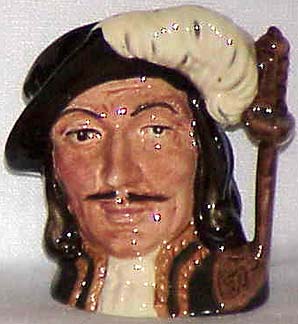
Though we be slight and not powerful in the world's eyes, that is no reason not to practice Marian chivalry. I'm sure Tolkien would agree wholeheartedly. Join us!
Sunday, January 25, 2009
Marian Chivalry
Though we be slight and not powerful in the world's eyes, that is no reason not to practice Marian chivalry. I'm sure Tolkien would agree wholeheartedly. Join us!

MacJesuits?
Read Deacon Greg Kandra's Is Mac Catholic? (Read esp. Umberto Eco's embedded essay, The Holy War: Mac vs. DOS)
Now a stroll down Amnesia Lane with a youthful Steve Jobs:
Now a stroll down Amnesia Lane with a youthful Steve Jobs:
MSM - Blinders On
 The mainstream media - hereafter referred to in this unvarnished history as the MSM - did an outstanding job of utterly ignoring such sights on the streets of Washington, DC on Wednesday as pictured in the above photo. This goes well with the new administration's commitments to the (let's pretend it is Ivy League progressivism, but it is really) neo-pagan, anti-life agenda so de rigueur in this present age. Is it any wonder John Paul II called it the culture of death?
It reminded me of Nixon watching NFL football while protesters marched against the Vietnam war in its arrogance.
Blessedly, the near-majority in the United States whose existential and ontological center is not founded upon whether or not the MSM pays attention to them or not don’t care.
We will continue to worship the God of Abraham, Isaac, and Jacob; the God revealed most perfectly in Jesus Christ, the "word made flesh" (Jn 1,14); obey the Ten Commandments as best we can with the help of God's grace; receive sacramental power and substantiation; raise our children to do the same; and pray always (a) for the conversion of sinners and (b) to remain firm in the faith in these dark days of the culture of death.
Saturday, January 24, 2009

Friday, January 23, 2009
Nihil
 For the record: NIHILISM - The Root of the Revolution of the Modern Age by Eugene (Fr Seraphim) Rose. [ht: Daniel Mitsui]
Ivy League Moloch Worship
 This is discrimination against the unborn most euphemistically; it is Moloch worship at its Ivy League, sangfroid, progressivist worst. All the more so because of the upward tilt of the head self-assurance.
It will not, cannot see its origins in paganism, because it thinks that functional atheism is the absence of religion. But who can hide from the consequences of their decisions in Heaven's sight? No one. No, not one.
UPDATE: B-Movie Catechism shows the inner machinations of the Moloch boys in the back room. [ht: Whapping]
AND AGAIN: Great (read: grace-touched) minds …
World Respects the Church
As well it should. Cardinal Bertone's words should be read slowly and carefully - lectio divina - and the question of Saint Peter ever before us: "Lord, to whom would we go? You have the words of eternal life" (Jn 6).
QUERETARO, Mexico, JAN. 22, 2009 (Zenit.org).- The Church is an institution that is esteemed and valued around the world, according to Benedict XVI's secretary of state.
Read all …This was one of the affirmations made Monday by Cardinal Tarcisio Bertone during a question-and-answer session following his address to the world of culture and education. The cardinal was in Mexico as the Pope's representative for the 6th World Meeting of Families, which ended last Sunday.
The following day, he spoke at a conference organized by the Mexican episcopate and the Diocese of Queretaro on "The Fulfillment of Reason in the Horizon of Faith."
After a discourse in which he invited listeners to reflect on the presence of the Church and Catholics in the public life of the nation and their role in the configuration of Mexican culture, the cardinal answered five questions from the crowd.
One questioner proposed that a concept exists of the Church as an "institution in crisis," and he noted discrepancy in those who profess to be Catholic but do not follow the Church's teachings in themes, for example, regarding sexual morality.
Cardinal Bertone, calling on his experience as secretary of state for the Holy See, which has diplomatic relations with 177 nations, assured that the Church is far from in crisis.
Instead, he said, "the Church is very appreciated." He noted how the "word of the Church" is sought, as well as its aid in education, particularly in Muslim countries.
The cardinal went on to acknowledge the questioner's concern with discrepancy between faith and life. He cautioned against a "religion of pure worship" versus a "religion of life, of testimony [...] of coherence of life." In this area, the Vatican official affirmed, there is much work to do in pastoral ministry.
Competent Catholics
Regarding a perceived loss of cultural leadership from Catholics -- in areas such as art, literature, etc., Cardinal Bertone called for professionals that are well-formed and "truly competent."
He affirmed that it is the moment for Christian laypeople to take on a leading role, but said that they must be "competent laypeople."
Thursday, January 22, 2009
St Francis and Chivalry

Here is an offering from Southwell Books that may interest a good many folk with a hankering for the renewal of Catholic culture: Gospel Chivalry: Franciscan Romanticism, by Mark of Whitstable (pen name of Father Mark Elvins, a Capuchin friar).
[ht: Mary Victrix]
Synopsis: How St. Francis of Assisi transformed the medieval code of chivalry into the religious Rule for his new order.
Southwell Books summarizes it:
At the time of St Francis, Europe was riven with almost constant feuding between local war lords, and the knight, with his horse and armour, played an important role in society both on and off the battlefield. In an attempt to control the behaviour of these knights and to limit the scandal of Christian people fighting one another, the Church encouraged and elaborated the code of chivalry. The ceremony of appointing a new knight to armed service was solemnised by a prayer vigil and vows that enjoined the new knight to live by the ideals of honour and defence of the weak. This tied in well with the romantic ideal of the knight as portrayed by the troubadours. Similarly, the temptations to adultery inevitable in a household where the lord was often away on campaigns were at least partially mitigated by the notion of ‘courtly love’, in which the lady was seen as an idealised, but unobtainable object of desire.
Sadly the attempt to Christianise the warrior class was only partly successful. In many cases the vows were ignored, or interpreted in the light of social status at court. Indeed, the emergence of the military Orders can be seen as an acknowledgement that the code of chivalry alone was insufficient.
As the son of a wealthy merchant, the young Francis was rich enough to aspire to join the knightly class. Whilst his family hoped for upward social mobility, Francis was attracted by the romantic ideal of the ballads. However. the stark reality of warfare and its effect on those who took part quickly disillusioned him. Francis set about reinventing the code of chivalry, taking its high ideals of largesse, joyfulness, courtesy and courage, and showing how they could be lived out as a religious way of life.
Each chapter of the fascinating study shows how St. Francis adapted a different element of the knightly life to the life of his Friars. It shows how his teachings and words are infused with the romance of the troubadours, but how in his hands the worldly ambitions of the age are replaced with the eternal values of the Gospels.
This is the perfect book for all devotees of St. Francis of Assisi. And all those who hanker after a lost ‘Arthurian’ age of courtesy and honour will be inspired to bring true romance back into the world by living according to the code of Gospel chivalry.
Hudson - Beauty and the Church

Deal W. Hudson sees another way that the fullness of the Christian faith converts and renews.
In 2oo2, Joseph Cardinal Ratzinger delivered a sermon, "The Feeling of Things, the Contemplation of Beauty," where he said:[T]he most convincing demonstration of [faith's] truth against every denial, are the saints, and the beauty that the faith has generated. Today, for faith to grow, we must lead ourselves and the persons we meet to encounter the saints and to enter into contact with the Beautiful.How much lost "connectedness" would be recovered if more attention were paid to encounters with "the Beautiful" in the liturgy, so that it was never perfunctory, listless, or offensive to the ear and eye?Don't misunderstand me. Beauty in the liturgy isn't just a matter of better music and homilies; it requires its proper form (i.e., rubrics) as prescribed by the Church.In a later column, I will argue that the beauty of liturgy, emanating from the Eucharistic sacrifice, has been marred by misguided liturgical improvisation. Dumbed-down liturgies have only increased the distance many Catholics feel from their Church, whatever their good intentions.
Read all of How Beauty Can Renew the Catholic Church. [ht: Spirit Daily]
Subscribe to:
Posts (Atom)