Tuesday, February 12, 2008

Sacrificial Preparation, Violence, & Virtue
The day of giants—though some of them were ogres—is certainly over among Middle East leaders. In fact, what is most remarkable fact is how unremarkable the current rulers are. There is both good and bad in this situation, since while there is no one capable of turning around a whole country Samson-like that also means there is no one likely to pull down the temple and crush everyone underneath. That is, with one possible exception we will discuss shortly.
The job description is as follows: Wanted: A strong charismatic nationalist figure to guide the Arabic-speaking world toward modernization along with stability, an acceptable peace with Israel, good relations with the West, and solidarity against threats from both non-Arab Iran and radical Islamists.
Of course, there is a mirror-image role that could also be filled: A strong charismatic nationalist figure to mobilize the Arabic-speaking world for battle with Israel , confrontation with the West, and solidarity against threats from both non-Arab Iran and radical Islamists. Read all …
If this is so, it does not lead to the hope that Islam is facing a demise of any kind. Rather, it may be an indication of an increasing number of ad hoc "priests" (anthropologically speaking) who are quite willing to succumb to Sudden Jihad Syndrome, as Daniel Pipes has coined the apt phrase, from heretofore seeming respectable positions in western society. The frenzy of sacrificial preparation is not a pretty experience in which to be caught.
Again, my recommendation remains vigilance, practice of the virtues including that of chivalry, and what Jack Wheeler says: Not give a damn about their envy!
This is short-hand for giving our best effort NOT to become embroiled in a mimetic doubling rivalry with jihadists. A state of scandal will not help disciples to be faithful if the sacrificial crisis peaks in its apotheosis of frenzy and violence (besides - it makes your trigger finger shaky). We must remain in a state of Grace to be of any help to those around us.
God continue to bless us in preserving the very best of the remains of Christendom in and through the sacramental power and grace of the Catholic Church.
Monday, February 11, 2008
Dhimmitude 101
Part One.
Part Two.
Part Three.
The Macabre Paganism of "Bodies" Exhibit
I can understand how some see beauty in "Bodies." But I saw macabre manikins dressed in death's latest fashions. I don't condemn people who like it. But people who object don't need to apologize, either.
The people who should be ashamed are those who don't care where the bodies came from.
"When I see pictures of the exhibit, I feel something," said Morris Tsai, a Chinese-American of Mount Auburn, who protested at the Museum Center. "Maybe it's in the eyes or facial structure, but I can totally see that they're Chinese and I feel sorry for them. For we have taken advantage of the fact that since they died poor and alone, that somehow consent isn't necessary to turn a human being into a museum piece."
He wonders how Americans would feel if the bodies were unclaimed victims of Katrina. The answer is obvious: There would be hell to pay.
"Allowing Chinese to be put on display diminishes me and others like me," Tsai said.
I'd say parading dead bodies for profit diminishes everybody.
Friends, Lovers, & Spouses
Valentine's Day is just three days away, but one Muslim politician is heading up a committee to make sure it goes completely ignored.
Kuwaiti MP Waleed Al-Tabtabae, head of the National Assembly’s Committee Monitoring Negative Alien Practices, will chair his group Wednesday to discuss ways to repress all public displays recognizing the international day of love.
“We want to discuss measures that should be taken by these ministries to prevent such alien events from impacting Kuwaiti society and spreading corruption among the Kuwaiti youth,” Al-Tabtabae told reporters Monday.
Committee member Islamist MP Jamaan Al-Harbash said many Islamic countries ban Valentine's Day celebrations because the holiday “spreads moral corruption.”
Pity the poor denizens of cultures whose only image for their deity is master to whom they are slaves. What else shall they be to their wives?
Sunday, February 10, 2008
Archbishop in a Bubble
Religion, Envy (Desire), & the Evil Eye
Conversion of England - Update
 An update on Fr Aiden Nichols' project to convert England. Fr Richard Neuhaus writes in FIRST THINGS the following:
Father John Christopher Aidan Nichols, O.P., is a figure to be reckoned with. Aidan Nichols, as he signs himself, has written extensively and authoritatively on the theology of Hans Urs von Balthasar and has also authored the very useful volume The Theology of Joseph Ratzinger. He has collaborated on several projects with Rowan Williams, the Archbishop of Canterbury, and is currently the first John Paul II Memorial Lecturer at Oxford University, the first lectureship in Catholic theology at Oxford since the sixteenth century.
In view of Nichols’ theological and ecumenical stature, it is rightly thought to be newsworthy when he brings out a little book titled Realm: An Unfashionable Essay on the Conversion of England. His proposal will, as you might expect, be receiving careful attention in the pages of First Things. The conversion of England is, of course, a topic with a long and troubled history. Some prefer to speak of the reconversion of England. As Eamon Duffy demonstrated in his marvelous study The Stripping of the Altars, the English were once a very Catholic people.
From a Catholic perspective, the Church of England is a schismatic form of the Church in England that should be restored to full communion with the bishop of Rome and those in communion with the bishop of Rome. In this ecumenical age, to be sure, this is not usually stated so bluntly. Father Nichols’ candid reopening of these questions is, as he says, unfashionable.
To say that the history of these questions is troubled is an understatement. Remember the Spanish Armada, the English martyrs of the sixteenth century (Thomas More, Edmund Campion, John Fisher, et al.), Bloody Mary, the Gunpowder Plot, and on and on. The identity and, at times, the very survival of England has been viewed as inseparable from the established church with the monarch as its supreme head. When in the nineteenth century Rome reinstated the Catholic hierarchy, first under the leadership of Cardinal Nicholas Wiseman and then under the former Anglican, Cardinal Henry Edward Manning, many Englishmen saw it as a direct assault upon the religious, cultural, and political definition of the nation.
Daring Conqueror Still Trying
Modernism was born of the false belief that a bridge may lie between the conceptions of Catholicism and those of unbelief; unable to build on theological ground, it sought another: this is the ground of art and literature. On it modernism has pitched its tent, and on it, doubtlessly, modernism will show itself to be a most daring conqueror. And the reason for this is very simple: artists and poets know no other master than their hearts and imaginations. And besides, we live in times when art and literature are granted a credit and an authority that is almost dogmatic... Modern literature, it is evident, is not Christian. In the novel and the short story, an unrestrained subjectivism rules, that cherishes the fantastic dream of a new religion for future men.
- Gaspard Decurtins, 1911 or earlier [h/t: Daniel Mitsui]
Cantalamessa on Demons
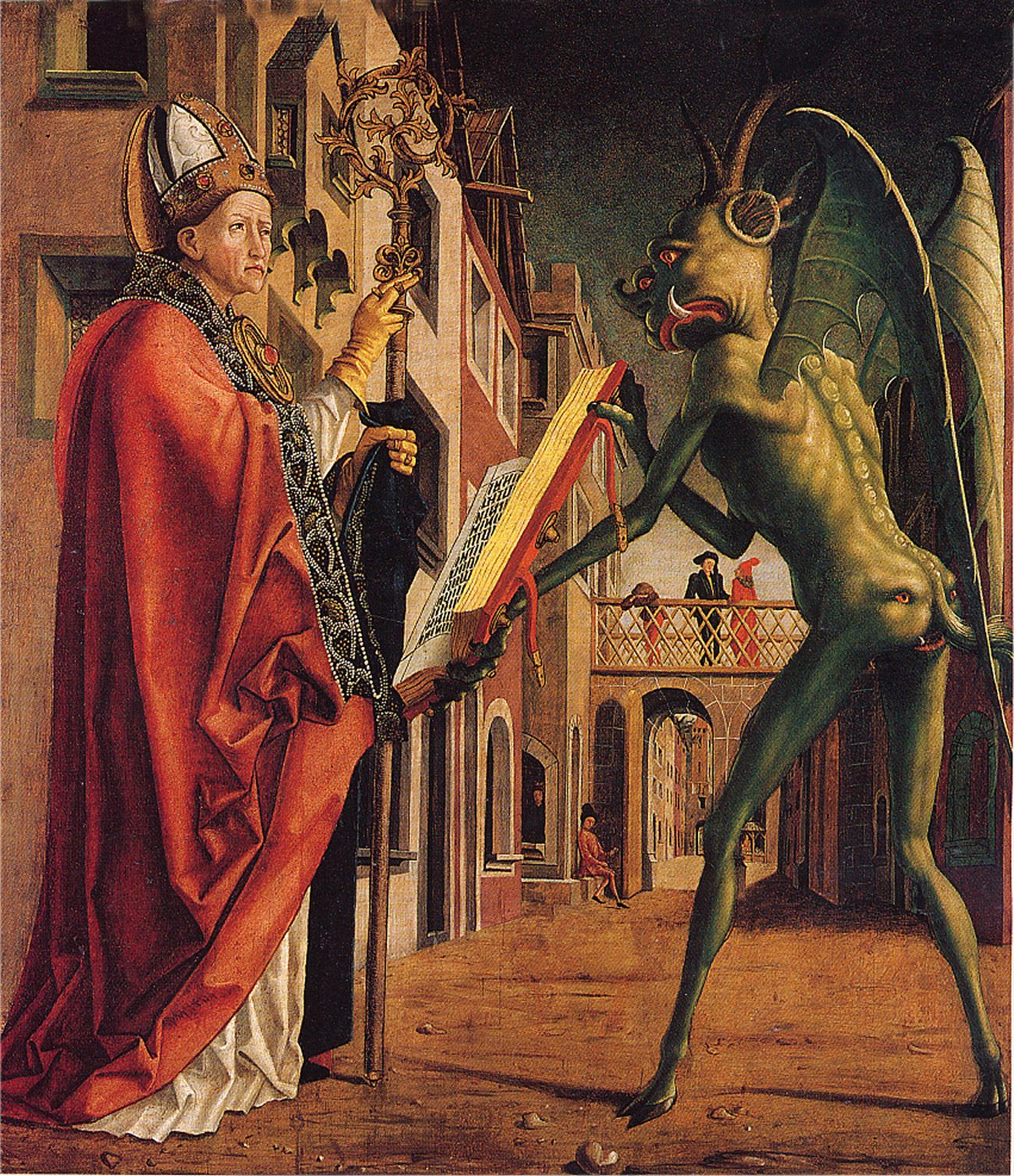 Saint Wolfgang and the Devil - Michael Pacher
Many intellectuals do not believe in demons in the first sense. But it must be noted that many great writers, such as Goethe and Dostoyevsky, took Satan's existence very seriously. Baudelaire, who was certainly no angel, said that "the demon's greatest trick is to make people believe that he does not exist." (And, yes, Girard says his second greatest trick is making people believe that he does exist, but that will be explained elsewhere.)
The principal proof of the existence of demons in the Gospels is not the numerous healings of possessed people, since ancient beliefs about the origins of certain maladies may have had some influence on the interpretation of these happenings. The proof is Jesus' temptation by the demon in the desert. The many saints who in their lives battled against the prince of darkness are also proof. They are not like "Don Quixote," tilting at windmills. On the contrary, they were very down-to-earth, psychologically healthy people.
If many people find belief in demons absurd, it is because they take their beliefs from books, they pass their lives in libraries and at desks; but demons are not interested in books, they are interested in persons, especially, and precisely, saints.
How could a person know anything about Satan if he has never encountered the reality of Satan, but only the idea of Satan in cultural, religious and ethnological traditions? They treat this question with great certainty and a feeling of superiority, doing away with it all as so much "medieval obscurantism." Real all ...
Saturday, February 9, 2008
Archbishop Not Scapegoated
Many would say the Archbishop is being scapegoated, but I beg to differ. That is like saying I am scapegoating the alarm clock by turning it off. The poor fellow woke up a somnambulating populace to the ramifications of its indolence -- "if you don't watch out you'll end up where you're headed" -- and he's tired of being knocked about by the alarum he's raised.
Now, of course he may actually believe what he's said, but the effect is the same. I think Morgan has teased out a very well written article on this episode and suggest you take a few moments to read it in full.
Virtues - Entrée to the Palace
 During this holy season of Lent, I want to explore the Virtues, both cardinal and theological in several interspersed posts. The first comes from a little book that Porthos, my fellow Mass'keteer brother, and I both have found useful on our spiritual journeys. It is entitled My Way of Life - Pocket Edition of St. Thomas, the Summa Simplified for Everyone (Confraternity of the Precious Blood):
The world of God as He is in Himself is not a world naturally open or accessible to man. But the infused virtues of faith, hope, and charity open up this world to God to man. It is as if a poor man were admitted to the palace of his king. He can roam the corridors almost at will, inspect almost all the rooms. And if he stays long enough and learns to behave as one should in the palace of the king, one day he will be admitted into the very presence of the king himself.
Faith, hope, and charity set man free in God's palace. By living a life of faith, in hope and charity he is preparing himself to be admitted into God's presence. If he dies with these virtues he will be admitted into God's presence. He will have achieved the purpose of his existence -- the attainment of the vision of God. [239]